Victorian Resources Online (archived)
Tall Wheat-Grass
Back | Salinity Indicator Plants Home | Common name home | Scientific name home | Photo Gallery | Glossary
| Tall Wheat-Grass photos | Family: Grass (Poaceae syn. Gramineae) |
| Scientific Name: | Lophopyrum ponticum (syn. Agropyrum elongatum, Elytrigia elongata, Elytrigia pontica, Elymus elongatus, Thinopyrum ponticum, Lophopyrum elongatum, Thinopyrum elongatum) | 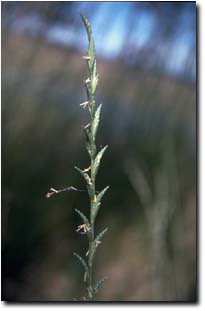 Flowering spike of Tall Wheat-grass Ex Matters & Bozon | |||||
Status: | Native to southern Europe and Asia Minor. Introduced into Victoria, South Australia, New South Wales and Tasmania as a fodder and reclamation grass for salt affected soils. | ||||||
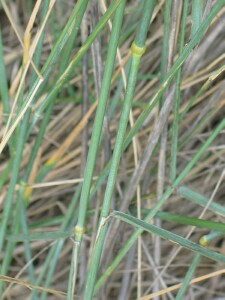
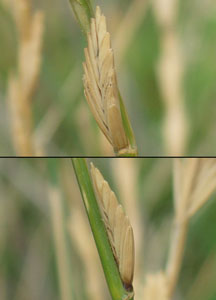
Plant Description: | Very tall, thick-stemmed, perennial grass, usually about 1 m tall, in clumps about 20 cm across. The stems are tough and smooth with prominent nodes. Leaves are long, flat to inrolled, prominently veined, more or less hairless and with a rough upper surface towards the sharply-pointed tips. Flower-heads are long (to 40 cm) erect, spikes and similar to wheat. The stalkless spikelets are 10-25 mm long, and grow out of notches either side of the stem, often curving away from the central stem (rachis) of the spike. Each spikelet is orientated with its flattened side towards the rachis and contains about 8-12 closely overlapping florets. Flowers spring to autumn. | ||||||
Habitat: | Prefers wet, saline, clay loams, and clays which dry and harden in summer.
| ||||||
Comments: | Tall Wheat-grass is considered to be a serious weed when it escapes into native wetland environments, as it can quickly become dominant through crowding out all other species. Controlled management of farm stands is essential to maximise livestock nutritional value, control vermin (e.g. rabbits, foxes) habitat, reduce fire hazard and prevent unintentional spread. Tall Wheat-grass may be confused with the ryegrasses in flower-head type, but the latter have spikelets that are orientated with their thin edge facing the rachis. |
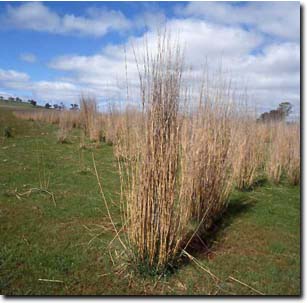 Mature stand of Tall Wheat-grass Ex Matters & Bozon |  Stand of Tall Wheat-grass with new growth emerging through remains of last season's tussock Photo: A J Brown |
|
Mature spike of Tall Wheat-grass Photo: A J Brown |
|
Spikelets of Tall Wheat-grass Photo: A J Brown |


Related Links
Department of Primary Industries - Information Note Series
- Establishing and managing tall wheat grass in saline soils for productivity
- Puccinellia ciliata for the Wimmera
