Victorian Resources Online (archived)
Espartillo (Achnatherum caudatum)
Present distribution
| 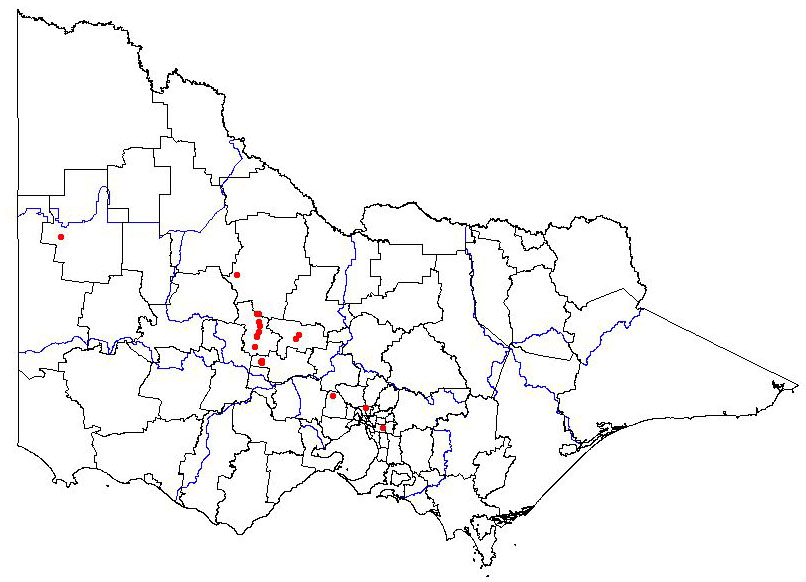 Map of the present distribution of Achnatherum caudatum | ||||
| Habitat: Native to Chile and Argentina. Found in riparian areas, lucerne crops and highly disturbed sites. Invades pasture after cultivation (McLaren et al 1998). Weed of grasslands, riparian vegetation, waste areas and roadsides (CCC 2005). | |||||
Potential distribution
Potential distribution produced from CLIMATE modelling refined by applying suitable landuse and vegetation type overlays with CMA boundaries
| Map Overlays Used Land Use: Pasture dryland; pasture irrigation. Broad vegetation types Coastal scrubs and grassland; coastal grassy woodland; heathy woodland; inland slopes woodland; sedge-rich woodland; grassland; plains grassy woodland; herb-rich woodland; riverine grassy woodland; rainshadow woodland; mallee woodland; wimmera/mallee woodland. Colours indicate possibility of Achnatherum caudatum infesting these areas. In the non-coloured areas the plant is unlikely to establish as the climate, soil or landuse is not presently suitable. | 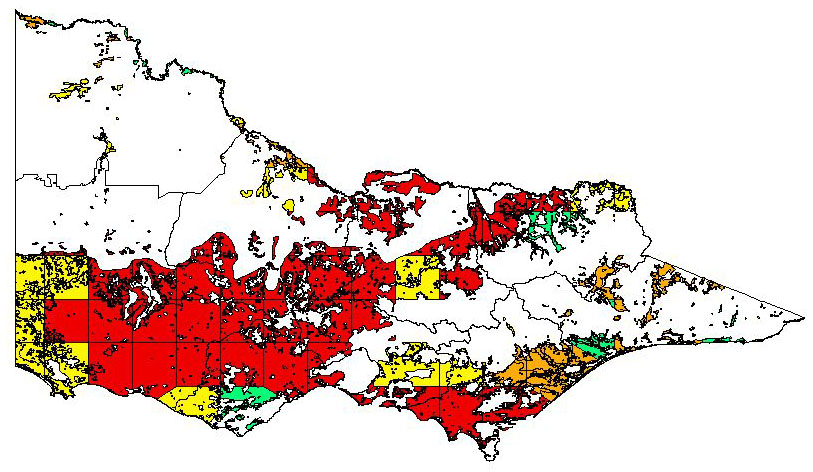
|
Impact
QUESTION | COMMENTS | RATING | CONFIDENCE |
| Social | |||
| 1. Restrict human access? | Tussock-forming perennial grass up to 100cm (Parsons & Cuthbertson 1992). Weed unlikely to restrict human access. | L | MH |
| 2. Reduce tourism? | Flowers throughout summer (Parsons & Cuthbertson 1992). Has purplish-brown flowers (CCC 2005). ‘Tall, stout, bright green perennial’ (Edgar & Connor 2000). Found in grasslands and open areas. May have minor effect on aesthetics of area, particularly when flowering. | ML | MH |
| 3. Injurious to people? | ‘Blades to 30cm long ..scabrous near the tip, the upper surface scabrous, somewhat sharp, the tip somewhat sharp (USU 2001). Leaf-blade ‘…with many small prickles on ribs’ (Edgar & Connor 2000). May cause some minor irritations. | ML | MH |
| 4. Damage to cultural sites? | Dense patches of tussocks likely to create a negative visual impact on cultural sites. | ML | MH |
| Abiotic | |||
| 5. Impact flow? | Terrestrial species (Parsons & Cuthbertson 1992). | L | MH |
| 6. Impact water quality? | Terrestrial species (Parsons & Cuthbertson 1992). | L | MH |
| 7. Increase soil erosion? | Fibrous root system (CCC 2005). Found in open areas and form tussocks which persist for many years. Low probability of large-scale soil movement. | ML | MH |
| 8. Reduce biomass? | Tussock-forming perennial grass up to 100cm. Usually found in waste places or open areas (Parsons & Cuthbertson 1992). Biomass likely to increase. | L | MH |
| 9. Change fire regime? | Tussock-forming perennial grass up to 100cm. Usually found in waste places or open areas (Parsons & Cuthbertson 1992). Moderate change to both frequency and intensity of fire risk. | MH | MH |
| Community Habitat | |||
| 10. Impact on composition (a) high value EVC | EVC=Coastal dune scrub (BCS =V); CMA=Glenelg Hopkins; Bioreg=Warrnambool Plain; CLIMATE potential=VH. Tussock-forming perennial grass which is a weed of grasslands, riparian vegetation, waste areas and roadsides (Parsons & Cuthbertson 1992). May cause a minor displacement of some dominant species within the lower strata. | ML | MH |
| (b) medium value EVC | EVC=Coastal alkaline scrub (BCS =D); CMA=West Gippsland; Bioreg=Gippsland Plain; CLIMATE potential=VH. Tussock-forming perennial grass which is a weed of grasslands, riparian vegetation, waste areas and roadsides (Parsons & Cuthbertson 1992). May cause a minor displacement of some dominant species within the lower strata. | ML | MH |
| (c) low value EVC | EVC=Heathy woodland (BCS =LC); CMA=Glenelg Hopkins; Bioreg=Glenelg Plain; CLIMATE potential=VH. Tussock-forming perennial grass which is a weed of grasslands, riparian vegetation, waste areas and roadsides (Parsons & Cuthbertson 1992). May cause a minor displacement of some dominant species within the lower strata. | ML | MH |
| 11. Impact on structure? | Tussock-forming perennial grass which is a weed of grasslands, riparian vegetation, waste areas and roadsides (Parsons & Cuthbertson 1992). Minor effect on the lower strata. | ML | MH |
| 12. Effect on threatened flora? | ‘Threatening the vulnerable hairy anchor plant (Discaria pubescens) at Creswick Creek (McPhee & May 1992, cited in McLaren et al 1998). | MH | MH |
| Fauna | |||
| 13. Effect on threatened fauna? | This species is not documented as posing an additional risk to threatened fauna. | MH | L |
| 14. Effect on non-threatened fauna? | ‘Palatable when young, but mature leaves are tough and rarely grazed by stock’ (Parsons & Cuthbertson 1992). Possible that this species will replace other native palatable species thereby reducing food for non-threatened fauna species. | ML | MH |
| 15. Benefits fauna? | ‘Palatable when young, but mature leaves are tough and rarely grazed by stock’ (Parsons & Cuthbertson 1992). Provides very little support to desirable species. | H | MH |
| 16. Injurious to fauna? | Weed not documented to be injurious to fauna. | L | MH |
| Pest Animal | |||
| 17. Food source to pests? | Not documented as a food source to pest species. | L | MH |
| 18. Provides harbor? | Not known to provide harbour for pest species. | L | MH |
| Agriculture | |||
| 19. Impact yield? | Problem in lucerne in Argentina and California ‘reducing yield and interfering with mowing’ (Parsons & Cuthbertson 1992). Major impact (5-20%) on quantity of produce. | MH | MH |
| 20. Impact quality? | Weed not documented to impact on quality of produce. | L | MH |
| 21. Affect land value? | Weed not documented to affect value of land. | L | MH |
| 22. Change land use? | ‘In pasture and lucerne paddocks, control is more difficult (Parsons & Cuthbertson 1992). Not documented but possible that there may be some change to use of land. | ML | M |
| 23. Increase harvest costs? | Problem in lucerne in Argentina and California … ‘interfering with mowing’ (Parsons & Cuthbertson 1992). Increase in time and labour to eradicate weed from paddocks. | M | MH |
| 24. Disease host/vector? | Weed not known as an alternative host or vector for disease of agriculture. | L | MH |
Invasive
QUESTION | COMMENTS | RATING | CONFIDENCE |
| Establishment | |||
| 1. Germination requirements? | Seeds germinate in autumn (Parsons & Cuthbertson 1992). Requires natural seasonal conditions for germination. | MH | MH |
| 2. Establishment requirements? | Habitat is primarily ‘open’ areas e.g. grasslands, roadside and pastures (Parsons & Cuthbertson 1992). Requires more specific requirements to establish. | ML | MH |
| 3. How much disturbance is required? | Established in ‘disturbed soils along roadsides, streambanks and waste places from which it invades run-down pastures’ (Parsons & Cuthbertson 1992). Establishes in highly disturbed natural ecosystems. | ML | MH |
| Growth/Competitive | |||
| 4. Life form? | Grass (in family Poaceae/Gramineae) (GRIN 2000). | MH | MH |
| 5. Allelopathic properties? | None described. | L | MH |
| 6. Tolerates herb pressure? | ‘Palatable when young, but mature leaves are tough and rarely grazed by stock’ (Parsons & Cuthbertson 1992). Consumed but non-preferred. | MH | MH |
| 7. Normal growth rate? | Growth rate is initially slow and also slows/ceases in winter (McLaren et al 1998). Only known to be a threat to one species (Parsons & Cuthbertson 1992). Maximum growth rate less than many species of the same life form. | ML | MH |
| 8. Stress tolerance to frost, drought, w/logg, sal. etc? | Tolerance to fire (Walsh & Entwistle 1994). Insufficient information to determine other tolerances. | M | L |
| Reproduction | |||
| 9. Reproductive system | Sexual reproduction. Two kinds of seed – open pollinated and self-pollinated (Parsons & Cuthbertson 1992). | ML | MH |
| 10. Number of propagules produced? | ‘Produces abundant hard awnless ‘nut-like’ cleistogenes’ (McLaren et al 1998). Well > 2000 possible See picture P & C (1992) p. 134 & 135. | H | MH |
| 11. Propagule longevity? | ‘Seeds often have dormancy mechanisms that allow them to persist for a long time.’ For example, Nassella neesiana and N. trichotoma have known seedbank longevities of 6 and 13 years respectively (Gardener & Sindel 1998). Achnatherum caudatum may exhibit similar longevity. | MH | ML |
| 12. Reproductive period? | Information on the life duration of this species is lacking. A related species Nassella trichotoma is known to be, “…long-lived, though the age which individuals can attain has not been determined.” Individuals may produce propagules for more than 3 years. | M | L |
| 13. Time to reproductive maturity? | Seeds germinate in autumn flowering, commences spring/summer following (Parsons & Cuthbertson 1992). Therefore assumed to produce propagules in less than a year. | H | MH |
| Dispersal | |||
| 14. Number of mechanisms? | Spread by water, stock and machinery (McLaren et al 1998). | MH | MH |
| 15. How far do they disperse? | Floodwaters and stock along stock routes are likely to disperse propagules 200 – 1000 m (McLaren et al 1998). | MH | MH |
References
Australian National Herbarium (ANH) 2006, Australia’s Virtual Herbarium, Australian National Herbarium, Centre for Plant Diversity and Research, viewed 01 Aug 2006 , http://www.anbg.gov.au/avh/
Campbell, M.H., Vere, D.T. 1995. Nassella trichotoma (Nees) Arech. In Biology of Australian Weeds, Volume 1. R.G. and F.J. Richardson, Meredith Victoria. p 193
Christchurch City Council (CCC) 2005, Puna grass: Achnatherum caudatum, Christchurch City Council, Weed of the month, viewed 09 Aug 2006, http://www.ccc.govt.nz/parks/theenvironment/WeedGuide/PDF/Mar2005.pdf BROKEN LINK
Department of Sustainability and Environment (DSE) 2004, Flora information system [CD-ROM], Biodiversity and Natural Resources Section, Viridans Pty Ltd, Bentleigh.
Edgar, E. and Connor, H. 2000, Flora of New Zealand: Volume 5 – Gramineae, Manaaki Whenua Press, Lincoln.
Gardnener, M.R., Sindel, B.M. 1998. The biology of Nassella and Achnatherum species naturalized in Australia and the implications for management on conservation lands. In Plant Protection Quarterly. Vol 13, No.2. . R.G. and F.J. Richardson, Meredith Victoria. pp. 76–79
Global Biodiversity Information Facility (GBIF) 2006, Global Biodiversity Information Facility, Data portal, viewed 01 Aug 2006 , http://www.gbif.org/
McLaren, D.A., Stajsic, V. and Gardener, M.R. 1998, ‘The distribution and impact of South/North American stipoid grasses (Poaceae: Stipeae) in Australia’, Plant Protection Quarterly, vol. 13, no. 2, pp. 62-70.
Parsons, W.T. & Cuthbertson, E.G. 1992, Noxious weeds of Australia, CSIRO Publishing, Collingwood.
Utah State University (USU) 2001, Achnatherum caudatum, USU, Herbarium, viewed 09 Aug 2006, http://herbarium.usu.edu/stipeae/achncaudatum.htm
Walsh, N. and Entwistle, T. (eds) (1994). Flora of Victoria: volume 2, ferns and allied plants,conifers and monocotyledons, Inkata Press, Melbourne.
Global present distribution data references
Australian National Herbarium (ANH) 2006, Australia’s Virtual Herbarium, Australian National Herbarium, Centre for Plant Diversity and Research, viewed 01 Aug 2006 , http://www.anbg.gov.au/avh/
Global Biodiversity Information Facility (GBIF) 2006, Global Biodiversity Information Facility, Data portal, viewed 01 Aug 2006 , http://www.gbif.org/
Utah State University (USU) 2001, Achnatherum caudatum, USU, Herbarium, viewed 09 Aug 2006, http://herbarium.usu.edu/stipeae/achncaudatum.htm
Feedback
Do you have additional information about this plant that will improve the quality of the assessment?
If so, we would value your contribution. Click on the link to go to the feedback form.
