Victorian Resources Online (archived)
Foxtail barley (Hordeum jubatum)
Present distribution
|  This weed is not known to be naturalised in Victoria | ||||
| Habitat: A dominant species of the Rocky Mountains of North America (Forcella 1992). Found in a variety of habitats including salt marsh and forest (Badger & Ungar 1994 and Namati & Goetz 1995). Invasive species within irrigated pasture and cropping especially in areas of minimal tillage (Conn 06 and Moyer & Boswell 2002). | |||||
Potential distribution
Potential distribution produced from CLIMATE modelling refined by applying suitable landuse and vegetation type overlays with CMA boundaries
| Map Overlays Used Land Use: Broadacre cropping; forest private plantation; forest public plantation; horticulture; pasture dryland; pasture irrigation Broad vegetation types Coastal scrubs and grassland; coastal grassy woodland; lowland forest; swamp scrub; box ironbark forest; inland slopes woodland; sedge rich woodland; dry foothills forest; moist foothills forest; montane dry woodland; montane moist forest; sub-alpine woodland; grassland; plains grassy woodland; valley grassy forest; herb-rich woodland; sub-alpine grassy woodland; montane grassy woodland; riverine grassy woodland; riparian forest; rainshadow woodland; mallee; mallee woodland; wimmera / mallee woodland Colours indicate possibility of Hordeum jubatum infesting these areas. In the non-coloured areas the plant is unlikely to establish as the climate, soil or landuse is not presently suitable. | 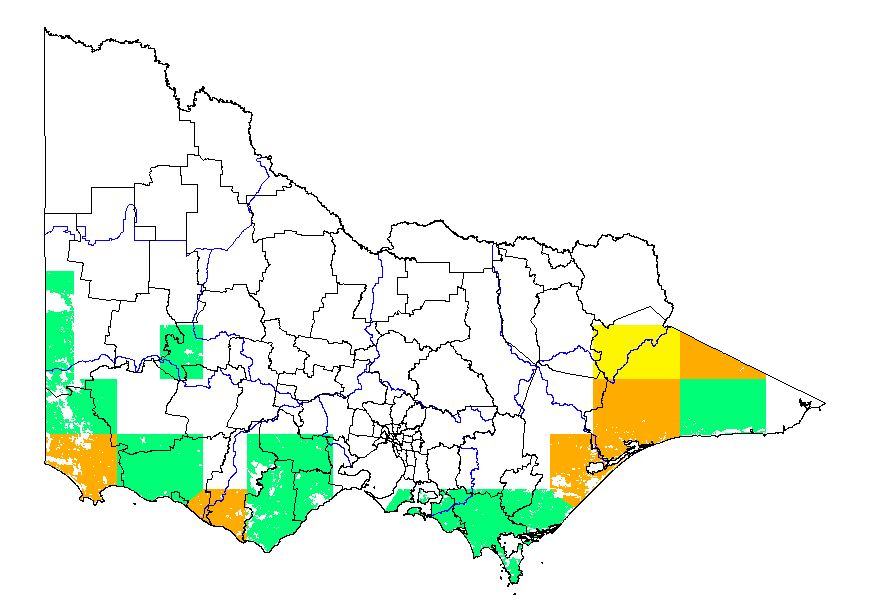
|
Impact
QUESTION | COMMENTS | RATING | CONFIDENCE |
| Social | |||
| 1. Restrict human access? | Grass species, does have sharp awns likely to be negligible factor. | l | m |
| 2. Reduce tourism? | Grass species, limited change to the aesthetics of an area. | l | m |
| 3. Injurious to people? | Possesses sharp awns which have been reported injuring cattle when being grazed by Moyer & Boswell (2002), and becoming longed in the eyes of hawks and causing death (McCrary & Bloom 1984). May cause injury if lodges in a sensitive area. | ml | m |
| 4. Damage to cultural sites? | Grass species. | l | m |
| Abiotic | |||
| 5. Impact flow? | Does grow in periodically flooded salt flats (Kindscher, Aschenbach & Ashworth 2004). However it would have only a minor effect on the low flow rates in this system. | l | m |
| 6. Impact water quality? | None reported. | l | m |
| 7. Increase soil erosion? | Is a ground cover in saline systems where few other species can thrive (Howes Keifer & Ungar 2002). However is still only a tufted grass species without a remarkable root system. | ml | m |
| 8. Reduce biomass? | Competitive with other grass species (Moyer & Boswell 2002). | ml | mh |
| 9. Change fire regime? | Unknown. | m | l |
| Community Habitat | |||
| 10. Impact on composition (a) high value EVC | EVC= Sub-alpine Grassland (V); CMA= East Gippsland; Bioreg= Highlands-Northern Fall; H CLIMATE potential. Can become a dominant species in the grass/herb layer. | ml | m |
| (b) medium value EVC | EVC= Montane Grassy Woodland (D); CMA= East Gippsland; Bioreg= Highlands-Northern Fall; H CLIMATE potential. Can become a dominant species in the grass/herb layer. | ml | m |
| (c) low value EVC | EVC= Sub-alpine Woodland (LC); CMA= East Gippsland; Bioreg= Highlands-Northern Fall; H CLIMATE potential. Can become a dominant species in the grass/herb layer. | ml | m |
| 11. Impact on structure? | Can become dominant within grass/herb layer (Moyer & Boswell 2002). | mh | mh |
| 12. Effect on threatened flora? | Can become dominant within grass/herb layer (Moyer & Boswell 2002). | mh | ml |
| Fauna | |||
| 13. Effect on threatened fauna? | Has been reported to have lethal effects on the red-shouldered hawk, as its sharp awns have become lodged in the eyes of the birds (McCrary & Bloom 1984). The awns have also been reported to cause mechanical damage to grazing species (White 1984). | ml | mh |
| 14. Effect on non-threatened fauna? | Has been reported to have lethal effects on the red-shouldered hawk, as its sharp awns have become lodged in the eyes of the birds (McCrary & Bloom 1984). The awns have also been reported to cause mechanical damage to grazing species (White 1984). | ml | mh |
| 15. Benefits fauna? | Is edible before seeding and after cured (Rocky Mountain Forest and Range Experiment Station). | mh | m |
| 16. Injurious to fauna? | Has been reported to have lethal effects on the red-shouldered hawk, as its sharp awns have become lodged in the eyes of the birds (McCrary & Bloom 1984). The awns have also been reported to cause mechanical damage to grazing species (White 1984). | h | mh |
| Pest Animal | |||
| 17. Food source to pests? | Eaten by cattle and game species, this could include deer and rabbits (White 1984). | mh | m |
| 18. Provides harbour? | Grass species, temporary at best. | mh | m |
| Agriculture | |||
| 19. Impact yield? | Can be used as a pasture species on salt effected land, superior pasture species can be chosen that will out compete it (Moyer & Boswell 2002). Not grazed once heads form (Best, Banting & Bowes 1978). | ml | m |
| 20. Impact quality? | Contaminant of grain and hay (Moyer & Boswell 2002). Can cause wool can be downgraded (Best, Banting & Bowes 1978). | ml | m |
| 21. Affect land value? | No evidence of this. | l | m |
| 22. Change land use? | No evidence of this. | l | m |
| 23. Increase harvest costs? | Contaminant of hay and grain, tendency for seed heads to from tangled mass may clog machinery. (Moyer & Boswell 2002). Cause injury to stock especially horses, which can lead to infection (Best, Banting & Bowes 1978). | m | mh |
| 24. Disease host/vector? | Alternate host for the Hessian Fly (Moyer & Boswell 2002). Able to be infected with Puccinia graminis, stem rusts of wheat, barley and oats (Harder etal 1996). | h | mh |
Invasive
QUESTION | COMMENTS | RATING | CONFIDENCE |
| Establishment | |||
| 1. Germination requirements? | Seeds have been found to be able to germinate from the time of dispersal when exposed to favourable temperatures, however germination in autumn had the best survivorship rates (Badger 1990). | mh | mh |
| 2. Establishment requirements? | A common understorey species under a canopy of pine and oak in North America (Namati & Goetz 1995). | mh | mh |
| 3. How much disturbance is required? | A dominant species within grassland communities (Forcella 1992). | mh | mh |
| Growth/Competitive | |||
| 4. Life form? | Grass species | mh | h |
| 5. Allelopathic properties? | None described | l | m |
| 6. Tolerates herb pressure? | Seed heads have stiff awns which can become imbedded in the mouths grazing animals (Moyer & Boswell 2002). Cattle often avoid it until after it has cured and dried (Rocky Mountain Forest and Range Experiment Station) | mh | mh |
| 7. Normal growth rate? | Can become dominant over many pasture species, can be suppressed by tall fescue and creeping foxtail (Moyer & Boswell 2002). | mh | mh |
| 8. Stress tolerance to frost, drought, w/logg, sal. etc? | Tolerant of salinity, dominant in soils of intermediate salinity on a salt pan (Burchill & Kenkel 1991). Tolerant of drought present in arid areas (Moyer & Boswell 2002). Tolerant of waterlogging, a problem weed in irrigated pastures (Moyer & Boswell 2002). | h | mh |
| Reproduction | |||
| 9. Reproductive system | Produces seed and can regenerate from buds within the root crown (Moyer & Boswell 2002). | h | mh |
| 10. Number of propagules produced? | In their third year of growth plants are capable of producing more than 188 flower spikes per plant, and from images each flower spike contains easily 10-20 seeds (Best, Banting & Bowes 1978). Which means plants capable of producing upwards of 2000 seeds. | h | m |
| 11. Propagule longevity? | Only 1% of seed remain viable after 3.7 years, buried in Alaska (Conn & Deck 1995). | l | mh |
| 12. Reproductive period? | At least three years (Best, Banting & Bowes 1978) | mh | mh |
| 13. Time to reproductive maturity? | Can flower and set seed within their first year (Best, Banting & Bowes 1978). | h | mh |
| Dispersal | |||
| 14. Number of mechanisms? | The seed heads break off and form a tangled mass when mature, which is then dispersed by wind (Moyer & Boswell 2002). The awns also enable the seeds to stick into animals (Best, Banting & Bowes 1978). | mh | mh |
| 15. How far do they disperse? | Wind dispersed, the tangled mass of seed heads is described as being capable of spreading seed over a wide area (Best, Banting & Bowes 1978). | mh | mh |
References
Badger. K.S. (1990) The salinity tolerance and the distributional ecology of Hordeum jubatum L.. Dissertation Abstracts International. B, Sciences and Engineering. 50: 5434-5435.
Badger. K.S. & Ungar. I.A. (1994) Seed bank dynamics in an inland salt marsh, with special emphasis on the halophyte Hordeum jubatum L.. International Journal of Plant Science. 155: 66-72.
Best. K.F., Banting. J.D. & Bowes. G.G. (1978) The Biology of Canadian Weeds. 31. Hordeum jubatum L.. Canadian Journal of Plant Science. 58: 699-708
Burchill. C.A. & Kenkel. N.C. (1991) Vegetation-environment relationships of an inland boreal salt pan. Canadian Journal of Botany. 69: 722-732.
Conn. J.S. (2006) Weed seed bank affected by tillage intensity for barley in Alaska. Soil & Tillage Research. 90: 156-161.
Conn. J.S. & Deck. R.E. (1995) Seed viability and dormancy of 17 weed species after 9.7 years of burial in Alaska. Weed Science. 43: 583-585
Forcella. F. (1992) Invasive weeds in the northern Rocky Mountains. Western Wildlands. 18: 2-5.
Harder. D.E., Dunsmore. K.M., Wilson. R.G. & Salmeron. J.J. (1996) Stem rusts on wheat and barley in Canada, and on oat in Canada and Mexico in 1994. Canadian journal of plant pathology. 18: 379-383.
Howes Keifer. C. & Ungar. I.A. (2002) Germination and establishment of halophytes on brine-affected soils. Journal of Applied Ecology. 39: 402-415.
Kindscher. K., Aschenbach. T. & Ashworth. S.M. (2004) Wetland vegetation response to restoration of sheet flow at Cheyenne Bottoms, Kansas. Restoration Ecology. 12: 368-375.
McCrary. M.D. & Bloom. P.H. (1984) Lethal effects of introduced grasses on red-shouldered hawks. Journal of Wildlife Management. 48: 1005-1008.
Moyer. J.R. & Boswell. A.L. (2002) Tall fescue or creeping foxtail suppresses foxtail barley. Canadian Journal of Plant Science. 82: 89-92.
Namati. N. & Goetz. H. (1995) Relationships of overstory to understory cover variables in a ponderosa pine/gambel oak ecosystem. Vegetatio. 119: 15-21.
Rocky Mountain Forest and Range Experiment Station (1943) Rocky Mountain Forest and Range Experiment Station, Annual Report of range management section for 1943. 22.
White. L.M. (1984) Foxtail barley heading, yield, and quality as influenced by growth regulators and a desiccant. Agronomy Journal. 76: 27-30.
Global present distribution data references
Conn. J.S. (2006) Weed seed bank affected by tillage intensity for barley in Alaska. Soil & Tillage Research. 90: 156-161.
Global Biodiversity Information Facility (GBIF) 2006, Global biodiversity information facility: Prototype data portal, viewed 27 Sep 2006, http://www.gbif.org/
Howes Keifer. C. & Ungar. I.A. (2002) Germination and establishment of halophytes on brine-affected soils. Journal of Applied Ecology. 39: 402-415.
Kindscher. K., Aschenbach. T. & Ashworth. S.M. (2004) Wetland vegetation response to restoration of sheet flow at Cheyenne Bottoms, Kansas. Restoration Ecology. 12: 368-375.
Feedback
Do you have additional information about this plant that will improve the quality of the assessment?
If so, we would value your contribution. Click on the link to go to the feedback form.
