Victorian Resources Online (archived)
Hairy Thornapple (Datura wrightii)
Present distribution
| 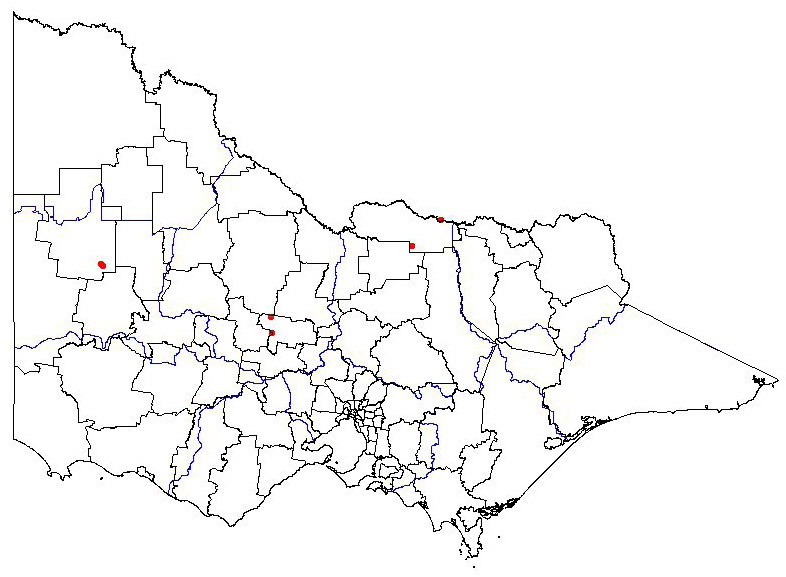 This weed is not known to be naturalised in Victoria Map showing the present distribution of this weed. | ||||
| Habitat: In its natural range present in riparian forest, grassland, freshwater marsh, coastal and montane scrub and desert habitats (Calflora 2006 and Elle & Hare 2000). Invasive in disturbed areas, cropping and pastures and has also been reported in relation to vineyards (Parsons & Cuthbertson 2001 and Wistrom & Purcell 2005). | |||||
Potential distribution
Potential distribution produced from CLIMATE modelling refined by applying suitable landuse and vegetation type overlays with CMA boundaries
| Map Overlays Used Land Use: Broadacre cropping; horticulture; pasture dryland; pasture irrigation Broad vegetation types Coastal scrubs and grassland; coastal grassy woodland; heathy woodland; lowland forest; heath; swamp scrub; box ironbark forest; inland slopes woodland; sedge rich woodland; dry foothills forest; montane dry woodland; sub-alpine woodland; grassland; plains grassy woodland; valley grassy forest; herb-rich woodland; subalpine grassy woodland; montane grassy woodland; riverine grassy woodland; riparian forest; rainshadow woodland; mallee; mallee heath; boinka-raak; mallee woodland; wimmera / mallee woodland Colours indicate possibility of Datura wrightii infesting these areas. In the non-coloured areas the plant is unlikely to establish as the climate, soil or landuse is not presently suitable. | 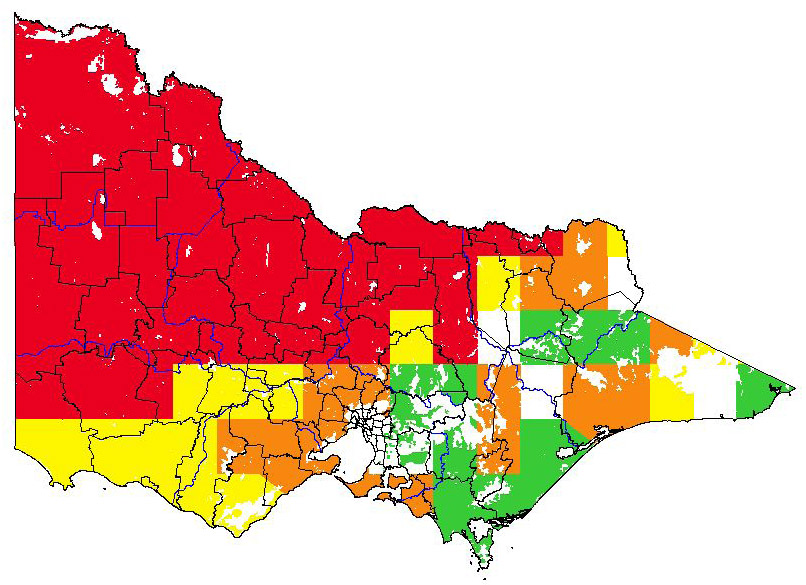
|
Impact
QUESTION | COMMENTS | RATING | CONFIDENCE |
| Social | |||
| 1. Restrict human access? | Poisonous, symptoms can present after just contact with the plant, also has thorny capsules (Parsons & Cuthbertson 2001). A definite impediment to individuals. | ml | mh |
| 2. Reduce tourism? | A shrubby herb with large ornate flowers, it would be noticed (Parsons & Cuthbertson 2001). However no reports of impacts on tourism. | m | m |
| 3. Injurious to people? | All parts of the plant are poisonous, especially seeds and fatalities have occurred after children have eaten seeds of the similar D. stramonium (Parsons & Cuthbertson 2001). Seed capsules are also thorny (Parsons & Cuthbertson 2001). | h | mh |
| 4. Damage to cultural sites? | Has larger root system than other Datura species, however no reports of it causing structural damage. Could alter the aesthetics with its large leaves and ornate flowers. | m | l |
| Abiotic | |||
| 5. Impact flow? | Terrestrial species. | l | m |
| 6. Impact water quality? | Terrestrial species. | l | m |
| 7. Increase soil erosion? | Has a large root system, however it does die back during the winter months (Parsons & Cuthbertson 2001). Therefore soil potentially exposed during times of highest rainfall, high probability of surface erosion. | mh | m |
| 8. Reduce biomass? | Can often create a shrubby herb layer, however as it is a short lived perennial, which dies back annually (Parsons & Cuthbertson 2001). Therefore has little capacity for acting as a carbon sink. | ml | mh |
| 9. Change fire regime? | Impact on fire not reported. | m | l |
| Community Habitat | |||
| 10. Impact on composition (a) high value EVC | EVC= Plains Grassy Woodland (E); CMA= Glenelg Hopkins; Bioreg= Glenelg Plain; VH CLIMATE potential. Most invasive in highly disturbed habitats, if present would compete for moisture light and nutrients (Parsons & Cuthbertson 2001). | l | mh |
| (b) medium value EVC | EVC= Heathy Herb-rich Woodland (D); CMA= Glenelg Hopkins; Bioreg= Glenelg Plain; VH CLIMATE potential. Most invasive in highly disturbed habitats, if present would compete for moisture light and nutrients (Parsons & Cuthbertson 2001). | l | mh |
| (c) low value EVC | EVC= Heathy Woodland (LC); CMA= Glenelg Hopkins; Bioreg= Glenelg Plain; VH CLIMATE potential. Most invasive in highly disturbed habitats, if present would compete for moisture light and nutrients may cause some minor displacement (Parsons & Cuthbertson 2001). | ml | mh |
| 11. Impact on structure? | Most invasive in highly disturbed habitats, if present would compete for moisture light and nutrients may cause some minor displacement (Parsons & Cuthbertson 2001). | l | mh |
| 12. Effect on threatened flora? | No reports of this, most invasive in highly disturbed environments (Parsons & Cuthbertson 2001). | l | mh |
| Fauna | |||
| 13. Effect on threatened fauna? | No evidence documented. | mh | l |
| 14. Effect on non-threatened fauna? | Poisonous plant (Parsons & Cuthbertson 2001). Minor hazard | ml | mh |
| 15. Benefits fauna? | Only insects seem to be able to use the plant as a food resource and no native species reported using it (Hare & Smith 2005 and Raguso et al 2003). | h | mh |
| 16. Injurious to fauna? | Poisonous (Parsons & Cuthbertson 2001). | h | mh |
| Pest Animal | |||
| 17. Food source to pests? | Bees can use the nectar (Parsons & Cuthbertson 2001). | ml | mh |
| 18. Provides harbour? | Shrubby herb that can cause poisoning symptoms from contact (Parsons & Cuthbertson 2001). Little evidence for potential harbour. | l | mh |
| Agriculture | |||
| 19. Impact yield? | Competes with crops for light, nutrients and moisture. Can also cause stock death especially in pigs and poultry (Parsons & Cuthbertson 2001 and Haegi 1976). | mh | m |
| 20. Impact quality? | Seed contamination of sorghum has lead to downgrading or rejection of the crop, and reported to cause birth defects in pigs (Parsons & Cuthbertson 2001). | h | m |
| 21. Affect land value? | No evidence of this reported. | m | l |
| 22. Change land use? | Seed contamination can’t easily be removed from sorghum (Parsons & Cuthbertson 2001). Therefore a different crop rotation would need to be put into place to produce a marketable product. | ml | m |
| 23. Increase harvest costs? | Can interfere with harvesting equipment (Parsons & Cuthbertson 2001). | m | mh |
| 24. Disease host/vector? | Alternate host for Xylella fastidiosa, the bacterium cause of Pierce’s disease of grapes (Wistrom & Purcell 2005). Alternate host for pests and diseases of crops such as tomatoes, tobacco and potatoes (Parsons & Cuthbertson 2001). | h | mh |
Invasive
QUESTION | COMMENTS | RATING | CONFIDENCE |
| Establishment | |||
| 1. Germination requirements? | In its native range seeds germinate during the winter rains (Hare & Smith 2005). In Australia can germinate throughout the year if has adequate soil moisture (Parsons & Cuthbertson 2001). | h | mh |
| 2. Establishment requirements? | Reported in scrubland therefore able to establish under moderate shading (Elle & Hare 2000). | mh | mh |
| 3. How much disturbance is required? | Most frequently found in of high disturbance, including roadsides, stock camps and under cultivation (Parsons & Cuthbertson 2001). In its native range reported in riparian forest (Calflora 2006). | m | mh |
| Growth/Competitive | |||
| 4. Life form? | Perennial herb (Parsons & Cuthbertson 2001). | l | mh |
| 5. Allelopathic properties? | Not reported for this species, however D. stramonium has been reported to have allelopathic effects (Parsons & Cuthbertson 2001). | m | l |
| 6. Tolerates herb pressure? | Herbivory by insects can decrease seed production (Elle & Hare 2000). Toxic with a unpleasant odour and therefore avoided, however cattle have been known to eat large amounts during drought with no ill effect (Parsons & Cuthbertson 2001). | mh | mh |
| 7. Normal growth rate? | Competitive with summer-growing crop species (Parsons & Cuthbertson 2001). | h | mh |
| 8. Stress tolerance to frost, drought, w/logg, sal. etc? | Occurs in desert areas, therefore drought tolerant (Raguso et al 2003). Senesces during the winter, to then regrow from rootstock, therefore frost tolerant (Hare & Smith 2005). Can occur in ephemeral streambeds, therefore tolerant of waterlogging (Hare & Elle 2004). | h | mh |
| Reproduction | |||
| 9. Reproductive system | Seeds, can be cross pollinated by a hawkmoth or be self pollinated. Flowers are often only open for one day (Hare & Smith 2005). | ml | h |
| 10. Number of propagules produced? | Plants capable of producing 14,000 viable seeds, most appear to produce less hover still more than 2000 (Hare & Elle 2004). | h | h |
| 11. Propagule longevity? | Seeds of a similar species D. stramonium have been found to be viable after being buried for 39 years (Parsons & Cuthbertson 2001). | h | m |
| 12. Reproductive period? | Most plants die after three years (Hare & Elle 2004). | m | h |
| 13. Time to reproductive maturity? | Can flower and set seed with in first year (Hare & Smith 2005). | h | h |
| Dispersal | |||
| 14. Number of mechanisms? | Seeds and seed capsules float (water), also spread through seed and fodder contamination (Parsons & Cuthbertson 2001). Thorny seed capsules could also attach to animals. | mh | mh |
| 15. How far do they disperse? | Water is capable of spreading seeds kilometres | mh | m |
References
Calflora: Information on California plants for education, research and conservation. [web application]. 2006. Berkeley, California: The Calflora Database [a nonprofit organization] viewed 23 Nov 2006, http://www.calflora.org/ .
Elle E. & Hare J.D. (2000) No benefit of glandular trichome production in natural populations of Datura wrightii. Oecologica. 123: 57-65.
Haegi L. (1976) Taxonomic account of Datura L. (Solanaceae) in Austalia with a note on Brugmansia Pers. Australian Journal of Botany. 24: 415-435.
Hare J.D. & Elle E. (2004) Survival and seed production of Sticky and Velvety Datura wrightii in the field: A five-year study. Ecology. 85: 615-622
Hare J.D. & Smith J.L. II (2005) Competition, herbivory and reproduction of trichome phenotypes of Datura wrightii. Ecology. 86: 334-339
Parsons W.T. & Cuthbertson E.G. (2001) Noxious weeds of Australia, 2nd ed., CSIRO Publishing, Collingwood.
Raguso R.A., Henzel C., Buchmann S.L. & Nabhan G.P. (2003) Trumpet flowers of the sonoran desert: Floral biology of Peniocereus Cacti and Sacred Datura. International Journal of Plant Science. 164: 877-892.
Wistrom C. & Purcell A.H. (2005) The fate of Xylella fastidiosa in Vineyard weeds and other alternate hosts in California. Plant Disease. 89: 994-999.
Global present distribution data references
Australian National Herbarium (ANH) 2006, Australia’s Virtual Herbarium, Australian National Herbarium, Centre for Plant Diversity and Research, viewed 23 Nov 2006 , http://www.anbg.gov.au/avh/
Calflora: Information on California plants for education, research and conservation. [web application]. 2006. Berkeley, California: The Calflora Database [a nonprofit organization] viewed 23 Nov 2006, http://www.calflora.org/ .
Global Biodiversity Information Facility (GBIF) 2006, Global biodiversity information facility: Prototype data portal, viewed 23 Nov 2006, http://www.gbif.org/
Missouri Botanical Gardens (MBG) 2006, w3TROPICOS, Missouri Botanical Gardens Database, viewed 23 Nov 2006, http://mobot.mobot.org/W3T/Search/vast.html
Feedback
Do you have additional information about this plant that will improve the quality of the assessment?
If so, we would value your contribution. Click on the link to go to the feedback form.
