Victorian Resources Online (archived)
Peppercorn tree (Schinus molle)
Invasive Assessment | Impact Assessment
| Scientific name: | Schinus molle L. |
Common Name: | Pepper tree, Peppercorn tree |
Habitat: | Native to tropical southern America (Weber 2003). Naturalised in Mediterranean and semi-arid regions around the world (Howard & Minnich 1989). Described as invading riverbanks, forests, shrubland, coastal dunes, beaches (Weber 2003) lowland grassland, grassy woodland, dry sclerophyll forest & woodland, riparian vegetation, rock outcrops (Carr et al 1992), forested wetland, canyons, savannah (Calflora 2007), abandoned farms, coastal vegetation, chenopod shrubland (Blood 2001), seasonal water courses and rocky escarpments, predominantly where rainfall is less than 600 mm (Muyt 2001). Densest stands develop on moist sites. Occurs in the South American Andes to an altitude of 3300 m (Howard & Minnich 1989). |
 Peppercorn tree foliage and fruit Photo: Mark Imhof |  Peppercorn tree fruit Photo: Angela Fadersen |
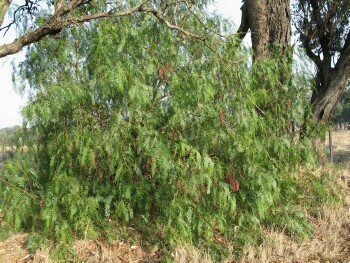 Young Peppercorn tree Photo: Mark Imhof |
