Victorian Resources Online (archived)
Pride of Madeira (Echium candicans)
Present distribution
| 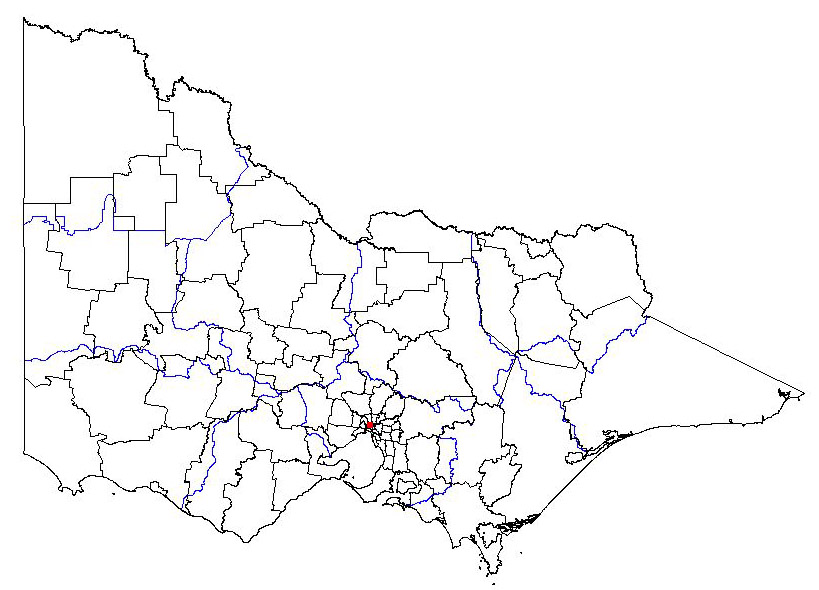 Map showing the present distribution of this weed. | ||||
| Habitat: The native range of E. candicans is in open laurel forest at the lower altitudes of the Canary Islands (Bennett 2003). It has been reported invading arable land in South Africa and open dry slopes, bluffs and grassland in California (Calflora 2006; HEAR 2006 and Wells 1986). | |||||
Potential distribution
Potential distribution produced from CLIMATE modelling refined by applying suitable landuse and vegetation type overlays with CMA boundaries
| Map Overlays Used Land Use: Broadacre cropping; forest private plantation; forest public plantation; horticulture; pasture dryland; pasture irrigation Broad vegetation types Coastal scrubs and grassland; coastal grassy woodland; lowland forest; box ironbark forest; inland slopes woodland; sedge rich woodland; dry foothills forest; moist foothills forest; grassland; plains grassy woodland; valley grassy forest; herb-rich woodland; riverine grassy woodland; rainshadow woodland Colours indicate possibility of Echium candicans infesting these areas. In the non-coloured areas the plant is unlikely to establish as the climate, soil or landuse is not presently suitable. | 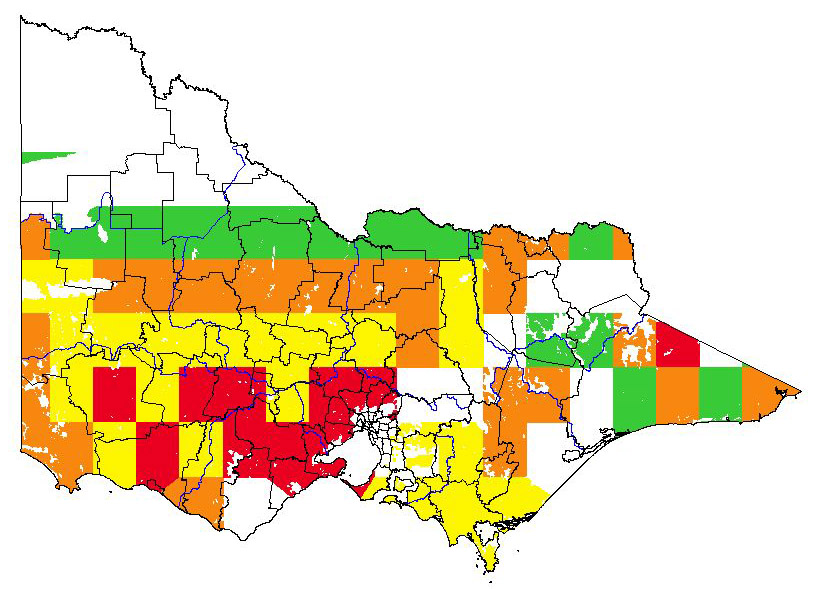
|
Impact
QUESTION | COMMENTS | RATING | CONFIDENCE |
| Social | |||
| 1. Restrict human access? | Leaves and inflorescences have bristles which can be irritating (Bennett 2003). | ml | mh |
| 2. Reduce tourism? | Planted as an ornamental, with potentially 6-7m flower spikes (Bennett 2003). Would alter the aesthetics however not reported impacting on tourism. | ml | l |
| 3. Injurious to people? | Bristles can be irritating (Bennett 2003). | ml | mh |
| 4. Damage to cultural sites? | No reported impacts, however is planted as an ornamental and could alter the aesthetics. | ml | m |
| Abiotic | |||
| 5. Impact flow? | Terrestrial species | l | m |
| 6. Impact water quality? | Terrestrial species | l | m |
| 7. Increase soil erosion? | Unknown. | m | l |
| 8. Reduce biomass? | As it is monocarpic doesn’t have the capacity for carbon sequestration. | ml | mh |
| 9. Change fire regime? | No impacts on fire regime reported. | l | l |
| Community Habitat | |||
| 10. Impact on composition (a) high value EVC | EVC= Grassy Woodland (E); CMA= Corangamite; Bioreg= Central Victorian Uplands; VH CLIMATE potential. Very similar to E. pininana, which has been reported to form dense stands (Robinson 1992) Therefore could potentially dominate the lower stratum. | mh | m |
| (b) medium value EVC | EVC= Herb-rich Foothill Forest (D); CMA= Corangamite; Bioreg= Central Victorian Uplands; VH CLIMATE potential. Very similar to E. pininana, which has been reported to form dense stands (Robinson 1992) Therefore could potentially dominate the lower stratum. | mh | m |
| (c) low value EVC | EVC= Lowland Forest (D); CMA= Corangamite; Bioreg= Central Victorian Uplands; VH CLIMATE potential. Very similar to E. pininana, which has been reported to form dense stands (Robinson 1992) Therefore could potentially dominate the lower stratum. | mh | m |
| 11. Impact on structure? | Very similar to E. pininana, which has been reported to form dense stands (Robinson 1992) Therefore could potentially dominate the lower stratum. | ml | m |
| 12. Effect on threatened flora? | No impacts reported. | mh | l |
| Fauna | |||
| 13. Effect on threatened fauna? | No impacts reported. | mh | l |
| 14. Effect on non-threatened fauna? | May displace more preferred food species, and irritating bristle may limit its use for habitat (Bennett 2003). Poisonous (Dave’s Garden 2006) | ml | m |
| 15. Benefits fauna? | Produced a lot of nectar for bees and other pollinators (Valido, Dupont & Olesen 2004). | mh | mh |
| 16. Injurious to fauna? | Has irritating bristles and other Echium species reported to be toxic (Bennett 2003). | m | m |
| Pest Animal | |||
| 17. Food source to pests? | Nectar source for bees (Dave’s Garden 2006). | ml | ml |
| 18. Provides harbour? | Not reported to be used as shelter. | l | m |
| Agriculture | |||
| 19. Impact yield? | Other species in the genus problem agricultural weeds, however E. candicans has not reported as weed of agriculture. May reduce production area. | m | l |
| 20. Impact quality? | Other species in the genus problem agricultural weeds, however E. candicans has not reported as weed of agriculture. | m | l |
| 21. Affect land value? | Other species in the genus problem agricultural weeds, however E. candicans has not reported as weed of agriculture. | m | l |
| 22. Change land use? | Other species in the genus problem agricultural weeds, however E. candicans has not reported as weed of agriculture. | m | l |
| 23. Increase harvest costs? | Other species in the genus problem agricultural weeds, however E. candicans has not reported as weed of agriculture. | m | l |
| 24. Disease host/vector? | Is susceptible to fungal disease (Bennett 2003). Unknown if these are in common with any agricultural crop, none reported. | l | m |
Invasive
QUESTION | COMMENTS | RATING | CONFIDENCE |
| Establishment | |||
| 1. Germination requirements? | Very little described, except for intentional propagation, where under greenhouse conditions if kept moist seeds will germinate within one to two weeks (Bennett 2003). These conditions may be a synthesis of rainfall and temperatures of the spring summer period. | mh | m |
| 2. Establishment requirements? | Native to open forest (Bennett 2003). Can therefore establish under moderate cover. | mh | mh |
| 3. How much disturbance is required? | Native to open forest (Bennett 2003). Has also been reported invading grassland habitat in California (Calflora 2006). | mh | mh |
| Growth/Competitive | |||
| 4. Life form? | Monocarpic shrub (Bennett 2003). | l | mh |
| 5. Allelopathic properties? | Echium species have been reported to have phenols in the leaves and phenols can inhibit the germination of some species (Marrero-Gomez et al 2000). | m | m |
| 6. Tolerates herb pressure? | Poisonous and leaves covered with bristles (Bennett 2003 and Dave’s Garden 2006). Would probably therefore be avoided. | mh | m |
| 7. Normal growth rate? | Reported as fast growing, able to grow to 2m in two years (Dave’s Garden 2006) | mh | ml |
| 8. Stress tolerance to frost, drought, w/logg, sal. etc? | Reported to be able to withstand temperatures to -60C (Dave’s Garden 2006). Therefore tolerant of frost. Drought tolerant (Dave’s Garden 2006). | ml | m |
| Reproduction | |||
| 9. Reproductive system | Sexual, (Bennett 2003). | ml | mh |
| 10. Number of propagules produced? | Inflorescences can be 3.5m tall, containing thousands of flowers all able to produce 4 nutlets (Bennett 2003). | h | mh |
| 11. Propagule longevity? | Unknown. | m | l |
| 12. Reproductive period? | Monocarpic (Bennett 2003). | l | mh |
| 13. Time to reproductive maturity? | Will flower within three years (Bennett 2003). | ml | mh |
| Dispersal | |||
| 14. Number of mechanisms? | Seeds have poorly developed wings (Lems 1960). Therefore has some capacity to be wind dispersed. | mh | mh |
| 15. How far do they disperse? | Wind dispersed but seeds not specially adapted for it (Lems 1960). | ml | m |
References
Bennett M. (2003) Pulmonarias and the Borage Family. B T Batsford. London.
Calflora: Information on California plants for education, research and conservation. [web application]. 2006. Berkeley, California: The Calflora Database [a non-profit organization] viewed 25 Sep 2006, http://www.calflora.org/ .
Dave’s Garden: Dave’s Garden “For Gardeners… By Gardeners”. viewed 11 Dec 2006, http://davesgarden.com/
HEAR: Hawaiian Ecosystems at Risk project, Invasive species information for Hawaii and the Pacific, viewed 7 Dec 2006, http://www.hear.org/
Lems K. (1960) Floristic botany of the Canary Islands: a compilation of the geographic distribution, dispersal types, life forms and leaf types of the species of vascular plants. Montreal : Institut Botanique de l'Universite de Montreal
Marrero-Gomez M.V., Arevalo. J.R., Banares-Baudet. A. Alamo. E.C. (2000) Study of the establishment of the endangered Echium acanthocarpum (Boraginaceae) in the Canary Islands. Biological Conservation. 94: 183-190
Robinson D.W. (1992) Increase of cold hardiness of Echium pininana through natural selection. Acta Horticulturae. 320: 33-37.
Wells M.J., Balsinhas A.A., Joffe H., Engelbrecht V.M., Harding G. & Stirton C.H. (1986) A catalogue of problem plants in southern Africa incorporating the national weed list of southern Africa. Memoirs of the Botanical Survey of South Africa. 53: 294.
Global present distribution data references
Calflora: Information on California plants for education, research and conservation. [web application]. 2006. Berkeley, California: The Calflora Database [a non-profit organization] viewed 25 Sep 2006, http://www.calflora.org/ .
FIS: Flora Information System 2005. Department of Sustainability and Environment.
Global Biodiversity Information Facility (GBIF) 2006, Global biodiversity information facility: Prototype data portal, viewed 25 Sep 2006, http://www.gbif.org/
Hansen A. & Sunding P. (1985) Flora of Macaronesia. Checklist of Vascular Plants. 3. Revised Edition. Botanical Garden and Museum. Oslo.
Lems K. (1960) Floristic botany of the Canary Islands: a compilation of the geographic distribution, dispersal types, life forms and leaf types of the species of vascular plants. Montreal : Institut Botanique de l'Universite de Montreal
Feedback
Do you have additional information about this plant that will improve the quality of the assessment?
If so, we would value your contribution. Click on the link to go to the feedback form.
