Victorian Resources Online (archived)
Pyp Grass (Ehrharta villosa)
Present distribution
| 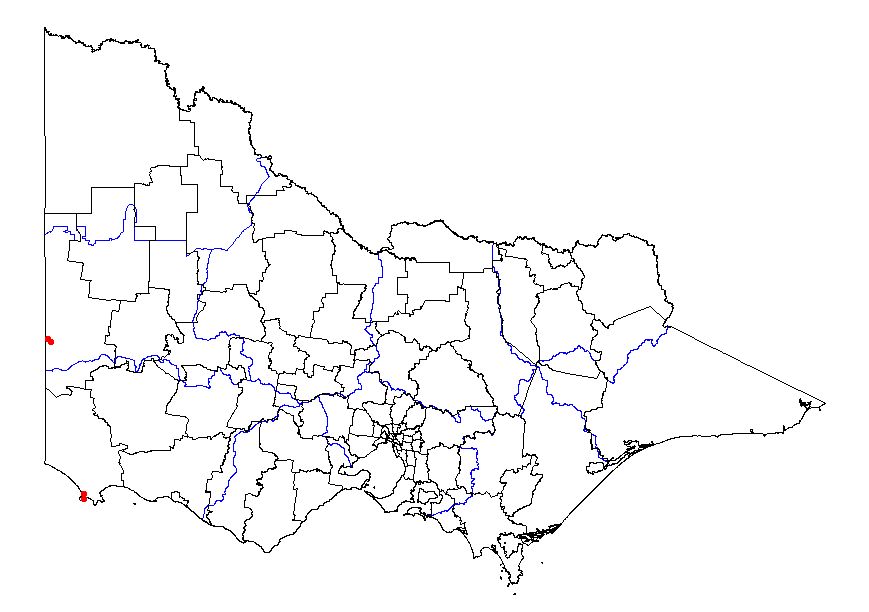 Map showing the present distribution of this weed. | ||||
| Habitat: Occurs on sandy soils within the Fynbos and Succulent Karoo Biomes in its native South Africa (Gibbs Russell. 1987). Establishes in dune systems both coastal and mallee (Herriot 1944 and Taylor 2004). | |||||
Potential distribution
Potential distribution produced from CLIMATE modelling refined by applying suitable landuse and vegetation type overlays with CMA boundaries
| Map Overlays Used Land Use: Pasture dryland on sandy soils. Broad vegetation types Coastal scrubs and grassland; coastal grassy woodland; grassland; plains grassy woodland; mallee; mallee heath; boinka-raak; mallee woodland; wimmera / mallee woodland (Restricted to sandy soils) Colours indicate possibility of Ehrharta villosa infesting these areas. In the non-coloured areas the plant is unlikely to establish as the climate, soil or landuse is not presently suitable. | 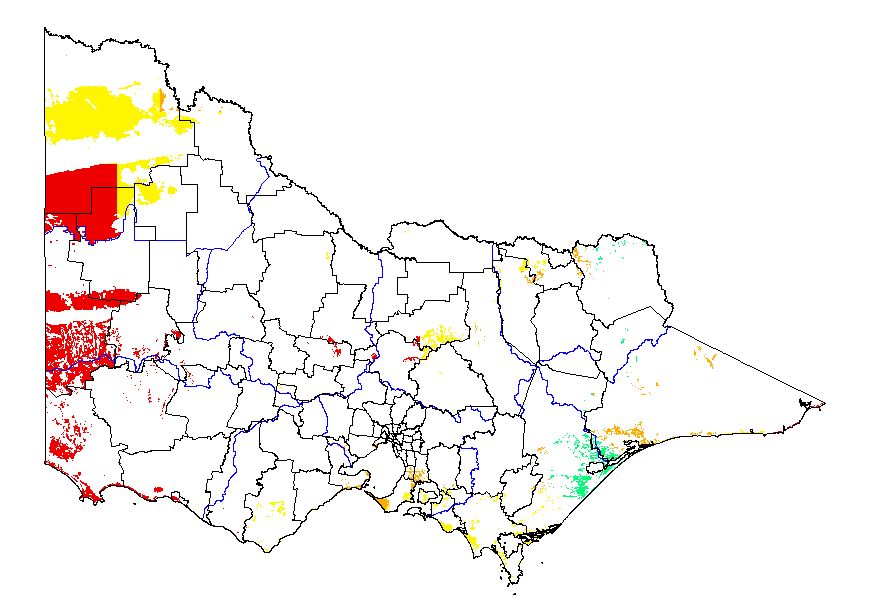
|
Impact
QUESTION | COMMENTS | RATING | CONFIDENCE |
| Social | |||
| 1. Restrict human access? | Can grow to 2m quite densely (Taylor 2004). | ml | mh |
| 2. Reduce tourism? | Changes the natural erosion patterns altering the character of coastal areas (Taylor 2004). | ml | m |
| 3. Injurious to people? | None described | l | m |
| 4. Damage to cultural sites? | Alters the natural erosion patterns of coastal and sandy areas (Taylor 2004). Changing the aesthetics of these areas. | ml | m |
| Abiotic | |||
| 5. Impact flow? | Terrestrial species | l | m |
| 6. Impact water quality? | Terrestrial species | l | m |
| 7. Increase soil erosion? | Used for sand stabilisation may even create problems for prevent natural levels erosion (Taylor 2004). | l | h |
| 8. Reduce biomass? | A dense mass of grass up to 2m high where there was previously sand, or more open vegetation (Taylor 2004). | l | mh |
| 9. Change fire regime? | Increasing the biomass, and also builds up large amounts of dead material increasing the fuel load potentially increasing the fire intensity (Taylor 2004). | ml | mh |
| Community Habitat | |||
| 10. Impact on composition (a) high value EVC | EVC= Plains Grassland (E); CMA= Mallee; Bioreg= Lowan Mallee; H CLIMATE potential. Can form monoculture in understorey. | h | mh |
| (b) medium value EVC | EVC= Shallow Sands Woodland (D); CMA= Mallee; Bioreg= Lowan Mallee; H CLIMATE potential. Can form monoculture in understorey. | h | mh |
| (c) low value EVC | EVC= Lowan Sands Mallee (LC); CMA= Mallee; Bioreg= Lowan Mallee; H CLIMATE potential. Can form monoculture in understorey. | h | mh |
| 11. Impact on structure? | Can smother out ephemerals and shrubs (Taylor 2004). | mh | mh |
| 12. Effect on threatened flora? | Can smother out species, and alters the erosion and disturbance pattens of the dune system (Taylor 2004). | mh | m |
| Fauna | |||
| 13. Effect on threatened fauna? | Alters the coastal habitat (Taylor 2004). | mh | ml |
| 14. Effect on non-threatened fauna? | Alters the habitat, potentially a reduction in food resources. | m | m |
| 15. Benefits fauna? | Dense grass would provide some shelter. | mh | m |
| 16. Injurious to fauna? | None reported | l | m |
| Pest Animal | |||
| 17. Food source to pests? | Not reported as food source for anything except galling nematode (Swart etal 2004). | l | mh |
| 18. Provides harbour? | Dense grass in sandy soil, prime habitat for rabbits. | h | ml |
| Agriculture | |||
| 19. Impact yield? | Not an agricultural weed, planted to reduce erosion and prevent further losses in soil fertility (Herriot 1944). | l | m |
| 20. Impact quality? | Not an agricultural weed, planted to reduce erosion and prevent further losses in soil fertility (Herriot 1944). | l | m |
| 21. Affect land value? | Not an agricultural weed, planted to reduce erosion and prevent further losses in soil fertility (Herriot 1944). | l | m |
| 22. Change land use? | Not an agricultural weed, planted to reduce erosion and prevent further losses in soil fertility (Herriot 1944). | l | m |
| 23. Increase harvest costs? | Not an agricultural weed. | l | m |
| 24. Disease host/vector? | Not an agricultural weed | l | m |
Invasive
QUESTION | COMMENTS | RATING | CONFIDENCE |
| Establishment | |||
| 1. Germination requirements? | Not specified, little observations of seed production or seedlings. Has been planted using seeds, as well as rhizomes (Mort. & Hewitt. 1953). | m | l |
| 2. Establishment requirements? | If present can invade intact dune systems (Taylor 2004), this could include underneath a moderate canopy. | mh | m |
| 3. How much disturbance is required? | If present can invade intact dune systems (Taylor 2004). | mh | mh |
| Growth/Competitive | |||
| 4. Life form? | Perennial rhizomatous grass (Harrington, Hodder. & Outred. 1998) | mh | h |
| 5. Allelopathic properties? | None described, though heavy thatching from dead material can prevent seed germination of other species (Taylor 2004). | l | mh |
| 6. Tolerates herb pressure? | Herb pressure not described, Is tolerant of a galling nematode (Swart etal 2004). Is a grass species with a vigorous rhizome system (Harrington, Hodder. & Outred. 1998). | mh | m |
| 7. Normal growth rate? | Rhizomes have been recorded spreading 9m in a year, and are able to grow up surrounding vegetation smothering other ground species (Harrington, Hodder. & Outred. 1998). | h | h |
| 8. Stress tolerance to frost, drought, w/logg, sal. etc? | Present in coastal dunes, Tolerant of salinity. Drought Tolerant: can grow in areas of that receive only 25mm annual rainfall (Herriot 1944). Presumed fire tolerance rhizome system protected underground. | h | mh |
| Reproduction | |||
| 9. Reproductive system | Largely vegetative by rhizome spread, can set seed, however little has been seen in Australia and few to no seedlings have been observed (Harrington, Hodder. & Outred. 1998). | h | h |
| 10. Number of propagules produced? | Low seed set, less than one viable seed per seed head (Harrington, Hodder. & Outred. 1998). | ml | m |
| 11. Propagule longevity? | Unknown, however spread largely vegetative (Harrington, Hodder. & Outred. 1998). | l | ml |
| 12. Reproductive period? | Can form monocultures (Taylor 2004). | h | mh |
| 13. Time to reproductive maturity? | Can produce material for vegetative spread within first season (Harrington, Hodder. & Outred. 1998). | h | h |
| Dispersal | |||
| 14. Number of mechanisms? | Dispersal described largely by human means for erosion control. | m | l |
| 15. How far do they disperse? | Unknown, most reports associated with previous planting’s. | m | l |
References
Harrington. K.C., Hodder. L.M. & Outred. HA. (1998) Biology and control of Pypgrass. Proceedings of the Fifty First New Zealand Plant Protection Conference. 255-259.
Herriot. R.I. (1944) Soil erosion. The problem in South Australia and what is being done about it. The Journal of the Department of Agriculture of South Australia. 48: 112-120.
Mort. G.W. & Hewitt. B.R. (1953) Vegetation survey of the marine sand drifts of New South Wales. Some remarks on useful stabilising species. Part 3. The Journal of the soil conservation of N.S.W. 9: 59-69.
Swart. A., Subbotin. S.A., Tiedt. L.R. & Riley. I.T. (2004) Anguina woodi sp. N. (Tylenchida: Anguinidae) from dune grass, Ehrharta villosa, in South Africa. Nematology. 6: 129-144.
Taylor. R. (2004) Coastal chameleons: good or bad grasses? Plant Protection Quarterly. 19: 80-81
Global present distribution data references
Australian National Herbarium (ANH) 2006, Australia’s Virtual Herbarium, Australian National Herbarium, Centre for Plant Diversity and Research, viewed 28 Aug 2006, http://www.anbg.gov.au/avh/
Gibbs Russell. G.E. (1987) Taxonomy of the genus Ehrharta (Poaceae) in Southern Africa: the Villosa group. Bothalia. 17:191-194.
Global Biodiversity Information Facility (GBIF) 2006, Global biodiversity information facility: Prototype data portal, viewed 25 Aug 2006, http://www.gbif.org/
Missouri Botanical Gardens (MBG) 2006, w3TROPICOS, Missouri Botanical Gardens Database, viewed 25 Aug 2006, http://mobot.mobot.org/W3T/Search/vast.html
Swart. A., Subbotin. S.A., Tiedt. L.R. & Riley. I.T. (2004) Anguina woodi sp. N. (Tylenchida: Anguinidae) from dune grass, Ehrharta villosa, in South Africa. Nematology. 6: 129-144.
Feedback
Do you have additional information about this plant that will improve the quality of the assessment?
If so, we would value your contribution. Click on the link to go to the feedback form.
