Victorian Resources Online (archived)
Rockspray cotoneaster (Cotoneaster microphyllus)
Present distribution
| 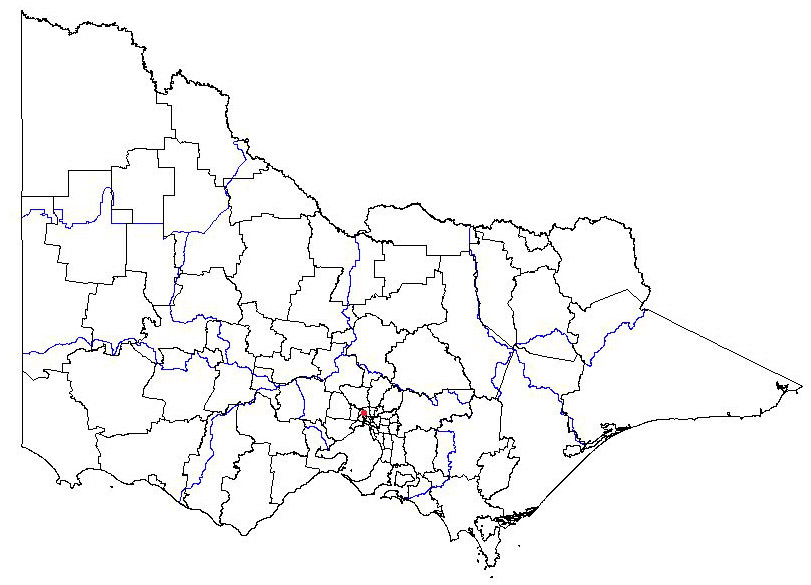 Map showing the present distribution of this weed. | ||||
| Habitat: Native to rocky slopes of the Himalayas (Wu et al 1994). Found to invade scrub, pasture and streamsides, especially in steep or well grazed areas in New Zealand (Webb, Sykes & Garnock-Jones 1988). Is reported ton not be tolerant of maritime exposure or waterlogging (PFAF 2002). | |||||
Potential distribution
Potential distribution produced from CLIMATE modelling refined by applying suitable landuse and vegetation type overlays with CMA boundaries
| Map Overlays Used Land Use: Horticulture; pasture dryland Broad vegetation types Heathy woodland; inland slopes woodland; sedge rich woodland; montane dry woodland; sub-alpine woodland; grassland; plains grassy woodland; herb-rich woodland; sub-alpine grassy woodland; montane grassy woodland; riverine grassy woodland; rainshadow woodland; wimmera / mallee woodland Colours indicate possibility of Cotoneaster microphyllus infesting these areas. In the non-coloured areas the plant is unlikely to establish as the climate, soil or landuse is not presently suitable. | 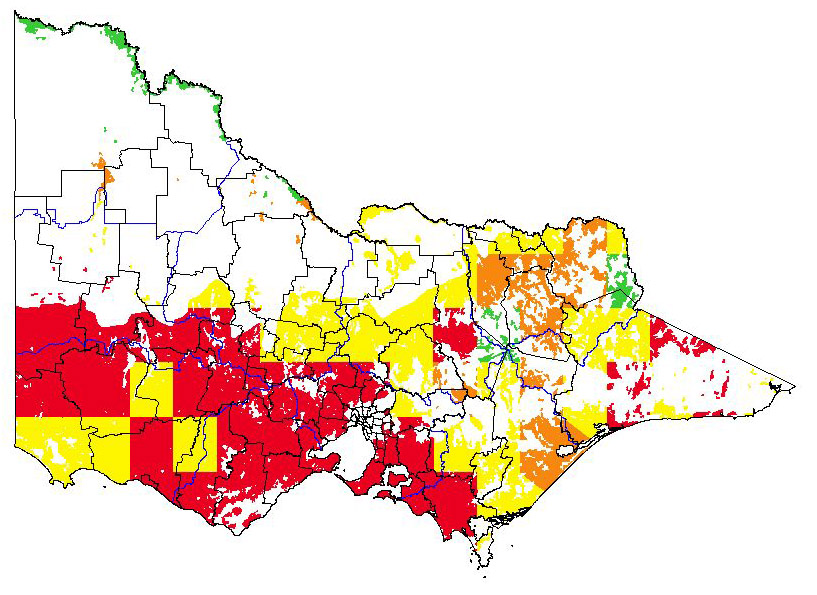
|
Impact
QUESTION | COMMENTS | RATING | CONFIDENCE |
| Social | |||
| 1. Restrict human access? | Is lower growing than other cotoneaster species, but has a spreading habit, which helps the plant to form dense vegetation (Bossard, Randell & Hoshovsky 2000). Would require works to create access. | h | mh |
| 2. Reduce tourism? | Ornamental species may alter the aesthetics. | ml | l |
| 3. Injurious to people? | Cotoneaster berries are poisonous if consumed in large quantities (Shepherd 2004). In 1983-84 1.29% of the reports involving plants made to the Poisons centres in Australia involved a Cotoneaster species (Covacevich, Davie & Pearn 1987). Has also been reported in association with four cases of urticaria (Ketel 1982). | ml | m |
| 4. Damage to cultural sites? | Ornamental species may alter the aesthetics. | ml | l |
| Abiotic | |||
| 5. Impact flow? | Terrestrial species | l | m |
| 6. Impact water quality? | Terrestrial species | l | m |
| 7. Increase soil erosion? | Has been used for soil conservation in their native range, as it spreads quickly on barren and grassy slopes (Singh, Bhagwati & Nawa 1992). | l | h |
| 8. Reduce biomass? | Reported to form dense low growing vegetation, which could be an increase in biomass of the woodland that it has invaded (Bossard, Randell & Hoshovsky 2000) | l | m |
| 9. Change fire regime? | Unknown, however a change in biomass could alter the fire intensity. | ml | l |
| Community Habitat | |||
| 10. Impact on composition (a) high value EVC | EVC= Plains Grassy Woodland (V); CMA= Glenelg Hopkins; Bioreg= Greater Grampians; VH CLIMATE potential. A prostrate shrub, braches will set root on contact with the ground, potential for major displacement (Bossard, Randell & Hoshovsky 2000). | mh | mh |
| (b) medium value EVC | EVC= Heathy Herb-rich Woodland (D); CMA= Glenelg Hopkins; Bioreg= Dundas Tablelands; VH CLIMATE potential. A prostrate shrub, braches will set root on contact with the ground, potential for major displacement (Bossard, Randell & Hoshovsky 2000). | mh | mh |
| (c) low value EVC | EVC= Rocky Outcrop Herbland (LC); CMA= Glenelg Hopkins; Bioreg= Greater Grampians; VH CLIMATE potential. A prostrate shrub, braches will set root on contact with the ground, potential for major displacement (Bossard, Randell & Hoshovsky 2000). | mh | mh |
| 11. Impact on structure? | A prostrate shrub, braches will set root on contact with the ground, potential for major displacement (Bossard, Randell & Hoshovsky 2000). | ml | mh |
| 12. Effect on threatened flora? | Unknown. | mh | l |
| Fauna | |||
| 13. Effect on threatened fauna? | Unknown | mh | l |
| 14. Effect on non-threatened fauna? | Alteration of habitat, creating dense low vegetation and potential altering flora composition (Bossard, Randell & Hoshovsky 2000). Therefore diversity in available food and shelter could be reduced. | ml | m |
| 15. Benefits fauna? | Additional food source through berries for bird species (PFAF 2002). Dense shrubby vegetation, used for nesting sites by bird species (Lu 2005). | m | mh |
| 16. Injurious to fauna? | Does have toxic properties, toxic to people (Shepherd 2004). However no detrimental effects to fauna reported, birds eat and disperse the berries (Bossard, Randell & Hoshovsky 2000). | l | m |
| Pest Animal | |||
| 17. Food source to pests? | Red berries attractive to frugivorous bird species (PFAF 2002). Visited by bees (PFAF 2002). | ml | m |
| 18. Provides harbor? | Used as nesting sites by blackbirds (Lu 2005). Creates low dense vegetation (Bossard, Randell & Hoshovsky 2000). Thickets may provide shelter for foxes and rabbits | m | m |
| Agriculture | |||
| 19. Impact yield? | Has been known to invade pasture (Webb, Sykes & Garnock-Jones 1988). Would then reduce production area. | l | mh |
| 20. Impact quality? | Unknown, however not reported to impact on agriculture. | l | m |
| 21. Affect land value? | Unknown, however not reported to impact on agriculture. | l | m |
| 22. Change land use? | Unknown, however not reported to impact on agriculture. | l | m |
| 23. Increase harvest costs? | Unknown, however not reported to impact on agriculture. | l | m |
| 24. Disease host/vector? | Susceptible to honey fungus (PFAF 2002). | m | m |
Invasive
QUESTION | COMMENTS | RATING | CONFIDENCE |
| Establishment | |||
| 1. Germination requirements? | For propagation of cotoneaster species, seed is recommended to be sown in autumn, or stratified over winter and then sown under glass in spring (Griffths 1992). Therefore there is a seasonal component to the germination of cotoneaster species. | mh | m |
| 2. Establishment requirements? | Tolerant of some shading (PFAF 2002). | mh | m |
| 3. How much disturbance is required? | Reported to invade pasture and riparian vegetation (Webb et al 1988). | mh | mh |
| Growth/Competitive | |||
| 4. Life form? | Shrub (Webb et al 1988). | l | mh |
| 5. Allelopathic properties? | No reported for this species, however C. salicifolius has been reported to allelopathic potential (Morita, Ito & Harada 2005). | m | l |
| 6. Tolerates herb pressure? | Not reported grazed, Other Cotoneaster species are tolerant of pruning (PFAF 2002). | mh | ml |
| 7. Normal growth rate? | Reported to be slow growing (PFAF 2002). | ml | mh |
| 8. Stress tolerance to frost, drought, w/logg, sal. etc? | Tolerant of temperatures to -250C (frost) (PFAF 2002). Not tolerant of maritime exposure (PFAF 2002). Susceptible of waterlogging (PFAF 2002). | ml | m |
| Reproduction | |||
| 9. Reproductive system | Reproduces sexually, producing seed (Bossard, Randell & Hoshovsky 2000). Cotoneaster species are capable of layering, where branches that are in constant contact with the ground can set root (Bossard, Randell & Hoshovsky 2000 and PFAF 2002). | h | mh |
| 10. Number of propagules produced? | Cotoneaster species produces abundant fruit, C. microphyllus contain 2 seeds (ed. Spencer 2002). | h | m |
| 11. Propagule longevity? | Due to the seeds germinating after a 14 month stratification study on C. horizontalis, seed viability was at 38% (Blomme & Degeyter 1985). Unknown however how long a seed can remain viable. | m | l |
| 12. Reproductive period? | Unknown however the plant is a shrub; Other Cotoneaster species have been reported to have lived longer then 25 years (Dave’s Garden 2006). With a presumed capacity to produce fruit 10+ years. | h | ml |
| 13. Time to reproductive maturity? | Unknown | m | l |
| Dispersal | |||
| 14. Number of mechanisms? | Produces red berries, which are then dispersed by birds and animals (Bossard, Randell & Hoshovsky 2000). | h | m |
| 15. How far do they disperse? | Birds and animals can disperse fruit seeds distances greater than 1km (Spennemann & Allen 2000). | h | mh |
References
Blomme R. & Degeyter L., 1985, Seed treatments and germination determinations for seeds of Cotoneaster horizontalis. Verbondsnieuws voor de Belgische Sierteelt. 29: 17-23
Bossard C.C., Randell J.M. & Hoshovsky M.C., 2000, Invasive plants of California’s wildlands. University of California Press.
Covacevich J., Davie P. & Pearn J., 1987, Toxic plants & animals. A guide for Australia. Queensland Museum. Brisbane
Dave’s Garden: Dave’s Garden “For Gardeners… By Gardeners”. viewed 18 Dec 2006, http://davesgarden.com/
Griffths M., 1992, The new Royal Horticultural Society dictionary of gardening. Macmillan. London
Ketel van W.G., 1982, Contact urticaria from Cotoneaster. Contact Dermatitis. 8: 139.
Lu X., 2005, Reproductive ecology of blackbirds (Turdus merula maximus) in a high-altitude location, Tibet. Journal of ornithology. 146: 72-78
Morita S., Ito M. & Harada J., 2005, Screening of an allelopathic potential in arbor species. Weed Biology and Management. 5: 26-30
PFAF: Plants for a Future. Edible, medicinal and useful plants for a healthier world. viewed 8 Dec 2002, http://pfaf.org/
Shepherd R.C.H., 2004, Pretty but poisonous. Plants poisonous to people, an Illustrated Guide for Australia. R.G. and F.J. Richardson. Meredith
Singh R.P., Bhagwati P. & Nawa B., 1992, Cotoneaster microphylla Wall. – suitable for soil conservation in temperate regions of Himalayas. Indian Forester. 118: 672-675
Spencer R. (ed), 2002, Horticultural Flora of South-Eastern Australia. Flowering Plants Dicotyledons Part 2. UNSW Press.
Spennemann. D.H.R. & Allen. L.R., 2000, Feral olives (Oliea europaea) as future woody weeds in Australia: a review. Australian Journal of Experimental Agriculture. 40: 889-901.
Webb C.J., Sykes W.R. & Garnock-Jones P.J., 1988, Flora of New Zealand, Vol 4, Botany Division, Department of Scientific & Industrial Research, New Zealand.
Wu Z., Raven P.H et al eds, 1994, Flora of China. 9: 102.
Global present distribution data references
Australian National Herbarium (ANH) 2006, Australia’s Virtual Herbarium, Australian National Herbarium, Centre for Plant Diversity and Research, viewed 4 Dec 2006, http://www.anbg.gov.au/avh/
Global Biodiversity Information Facility (GBIF) 2006, Global biodiversity information facility: Prototype data portal, viewed 1 Dec 2006, http://www.gbif.org/
Missouri Botanical Gardens (MBG) 2006, w3TROPICOS, Missouri Botanical Gardens Database, viewed 1 Dec 2006, http://mobot.mobot.org/W3T/Search/vast.html
Feedback
Do you have additional information about this plant that will improve the quality of the assessment?
If so, we would value your contribution. Click on the link to go to the feedback form.
