Victorian Resources Online (archived)
Sword sedge (Juncus ensifolius)
Present distribution
|  This weed is not known to be naturalised in Victoria | ||||
| Habitat: Grass-like wetland species (Champoeg Nursery). ‘Full sun or part shade’ (Robson et al. 2008). ‘Grow in sun to shade in moist soil or water to 2 inches deep (Riffle et al. 2008). Grows on margins of springs, streams, ponds and in seepage areas at moderate to high elevations (USGS). ‘Moist to wet soil moisture…common in wet meadows’ (SoundNative). ‘Low drought tolerance and restricted water conditions’ (Garden Guides). Tolerates seasonal flooding’ (Speichert and Speichert 2004). Moderate tolerance to salinity (USDA). Elevations up to 9000ft (Calflora). | |||||
Potential distribution
Potential distribution produced from CLIMATE modelling refined by applying suitable landuse and vegetation type overlays with CMA boundaries
| Map Overlays Used Land Use: Broadacre cropping; Pasture irrigation; water Ecological Vegetation Divisions Coastal; swampy scrub; freshwater wetland (permanent); treed swampy wetland; lowland forest; foothills forest; forby forest; damp forest; riparian; wet forest; high altitude shrubland/woodland; high altitude wetland; alpine treeless; granitic hillslopes; rocky outcrop shrubland; western plains woodland; riverine woodland/forest; freshwater wetland (ephemeral) Colours indicate possibility of Juncus ensifolius infesting these areas. In the non-coloured areas the plant is unlikely to establish as the climate, soil or landuse is not presently suitable. | 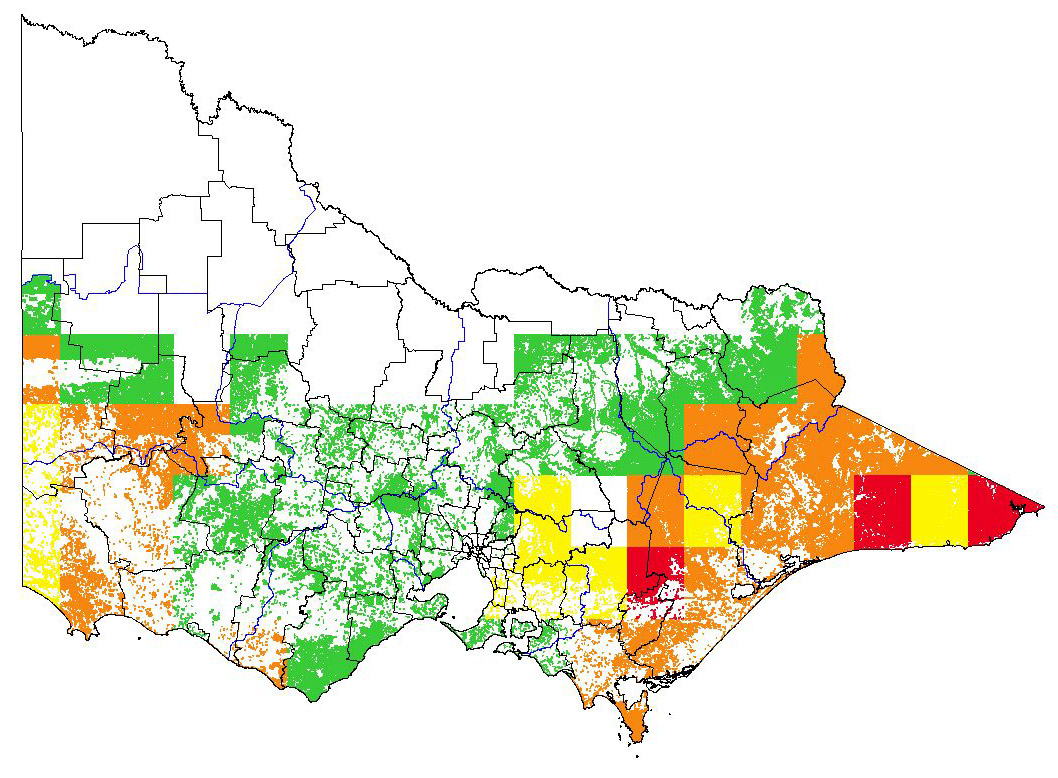
|
Impact
QUESTION | COMMENTS | RATING | CONFIDENCE |
| Social | |||
| 1. Restrict human access? | |||
| 2. Reduce tourism? | |||
| 3. Injurious to people? | |||
| 4. Damage to cultural sites? | |||
| Abiotic | |||
| 5. Impact flow? | |||
| 6. Impact water quality? | |||
| 7. Increase soil erosion? | |||
| 8. Reduce biomass? | |||
| 9. Change fire regime? | |||
| Community Habitat | |||
| 10. Impact on composition (a) high value EVC | |||
| (b) medium value EVC | |||
| (c) low value EVC | |||
| 11. Impact on structure? | |||
| 12. Effect on threatened flora? | |||
| Fauna | |||
| 13. Effect on threatened fauna? | |||
| 14. Effect on non-threatened fauna? | |||
| 15. Benefits fauna? | |||
| 16. Injurious to fauna? | |||
| Pest Animal | |||
| 17. Food source to pests? | |||
| 18. Provides harbor? | |||
| Agriculture | |||
| 19. Impact yield? | |||
| 20. Impact quality? | |||
| 21. Affect land value? | |||
| 22. Change land use? | |||
| 23. Increase harvest costs? | |||
| 24. Disease host/vector? |
Invasive
QUESTION | COMMENTS | RATING | CONFIDENCE |
| Establishment | |||
| 1. Germination requirements? | |||
| 2. Establishment requirements? | |||
| 3. How much disturbance is required? | |||
| Growth/Competitive | |||
| 4. Life form? | |||
| 5. Allelopathic properties? | |||
| 6. Tolerates herb pressure? | |||
| 7. Normal growth rate? | |||
| 8. Stress tolerance to frost, drought, w/logg, sal. etc? | |||
| Reproduction | |||
| 9. Reproductive system | |||
| 10. Number of propagules produced? | |||
| 11. Propagule longevity? | |||
| 12. Reproductive period? | |||
| 13. Time to reproductive maturity? | |||
| Dispersal | |||
| 14. Number of mechanisms? | |||
| 15. How far do they disperse? |
References
Brunt, A.A., Crabtree, K., Dallwitz, M.J., Gibbs, A.J., Watson, L. and Zurcher, E.J. (eds.) (1996 onwards). `Plant Viruses Online: Descriptions and Lists from the VIDE Database. Version: 20th August 1996.' Available at http://biology.anu.edu.au/Groups/MES/vide/ (verified 28 April 2009).
CalFlora (no date) available at http://www.calflora.org/cgi-bin/species_query.cgi?where-calrecnum=4464 (verified 02 April 2009)
Champoeg Nursery (2003-2006), available at http://champoegnursery.com/detail.asp?ScientificName=Juncus%20ensifolius (verified 02 April 2009).
Garden Guides (no date) Juncus ensifolius, available at http://www.gardenguides.com/plants/plant.asp?symbol=JUEN (verified 07 April 2009).
King County Native Plant Guide (2008) Dagger Leaved Rush. Available at http://green.kingcounty.gov/GoNative/Plant.aspx?Act=view&PlantID=139 (verified 02 April 2009).
Riffle RL, Speichert G, Speichert S (2008) Timber Press Pocket Guide to Water Garden Plants. Timber Press.
Robson K, Richter A, Filbert M (2008) Encyclopaedia of Northwest Native Plants for Gardens and Landscapes. Timber Press
Speichert S, Lovejoy A (2004) Encyclopaedia of Water Garden Plants. Timber Press.
Sound Native Plants (2009) Juncus ensifolius Dagger leaf rush, available at http://www.soundnativeplants.com/catalogemergents.htm (verified 02 April 2009).
USDA, NRCS (2009) The PLANTS Database. Juncus ensifolius Conservation Plant Characteristics. Available at http://plants.usda.gov/java/charProfile?symbol=JUEN (verified 07 April 2009).
USGS (2006) Aquatic and Wetland Vascular Plants of the Northern Great Plains 61. Juncaceae, The Rush Family. Available at
http://www.npwrc.usgs.gov/resource/plants/vascplnt/species/jens.htm (verified 07 April 2009)
Global present distribution data references
Australian National Herbarium (ANH) (2008) Australia’s Virtual Herbarium, Australian National Herbarium, Centre for Plant Diversity and Research, Available at
http://www.anbg.gov.au/avh/ (verified 07 April 2009).
Royal Botanic Gardens Melbourne. (2003) Census of Vascular Plants of Victoria. Available at http://www.rbg.vic.gov.au/research_and_conservation/plant_information/viclist (verified 07 April 2009).
Department of the Environment and Heritage (Commonwealth of Australia). (1993 – On-going) Australian Plant Name Index (APNI) http://www.cpbr.gov.au/apni/index.html (verified 07 April 2009).
Missouri Botanical Gardens (MBG). w3TROPICOS, Missouri Botanical Gardens Database (2009). Available at http://mobot.mobot.org/W3T/Search/vast.html (verified 07 April 2009).
United States Department of Agriculture. Agricultural Research Service, National Genetic Resources Program. Germplasm Resources Information Network - (GRIN) [Online Database]. Taxonomy Query. (2008) Available at http://www.ars-grin.gov/cgi-bin/npgs/html/taxgenform.pl (verified 07 April 2009).
Department of Sustainability and Environment (DSE) (2006) Flora information system [CD-ROM], Biodiversity and Natural Resources Section, Viridans Pty Ltd, Bentleigh.
EIS: Environmental Information System (2006) Parks Victoria.
IPMS: Integrated Pest Management System (2006) Department of Primary Industries.
Feedback
Do you have additional information about this plant that will improve the quality of the assessment?
If so, we would value your contribution. Click on the link to go to the feedback form.
