Victorian Resources Online (archived)
White briony (Bryonia cretica ssp. dioica)
Present distribution
| 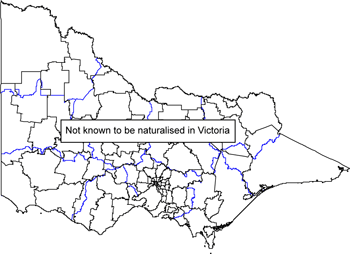 This weed is not known to be naturalised in Victoria | ||||
| Habitat: “On non-rockface soil…[one of] the chief competitors being the creeper Bryonia cretica subsp. Dioica (Jacq.)” (Navarro and Guitian 2003). “The whole plant is rather succulent” (Grieve 1994). “In diverse habitats such as hedges, fence lines, rank grass, native forest, scrub, paddocks and exotic plantations” (Biosecurity NZ 2009). “Able to tolerate wet to seasonal drought, warm to cool and a variety of soils…Stream edges, disturbed open forest and shrubland” (HRC 2003). “The plant prefers neutral and basic (alkaline) soils. It can grow in semi-shade (light woodland) or no shade. It requires moist soil…Woodland garden; dappled shade…Avoiding acid soils in the wild…Fond of lime soils” (PFAF Undated). It grows scattered on “bushes, wet woods, and winegrowing regions” (AVPE undated). “The Mediterranean woodlands and shrublands, semi-steppe shrublands, montane vegetation of Mt Hermon” (FII undated). | |||||
Potential distribution
Potential distribution produced from CLIMATE modelling refined by applying suitable landuse and vegetation type overlays with CMA boundaries
| Map Overlays Used Land Use: Broadacre cropping; forestry; horticulture perennial; horticulture seasonal; pasture dryland; pasture irrigation; water Ecological Vegetation Divisions Coastal; heathland; grassy/heathy dry forest; swampy scrub; freshwater wetland (permanent); treed swampy wetland; lowland forest; foothills forest; forby forest; damp forest; riparian; wet forest; rainforest; high altitude shrubland/woodland; high altitude wetland; alpine treeless; granitic hillslopes; rocky outcrop shrubland; western plains woodland; basalt grassland; alluvial plains grassland; semi-arid woodland; alluvial plains woodland; ironbark/box; riverine woodland/forest; freshwater wetland (ephemeral); saline wetland; chenopod shrubland; chenopod mallee; hummock-grass mallee; lowan mallee; broombush whipstick Colours indicate possibility of Bryonia cretica ssp. dioica infesting these areas. In the non-coloured areas the plant is unlikely to establish as the climate, soil or landuse is not presently suitable. | 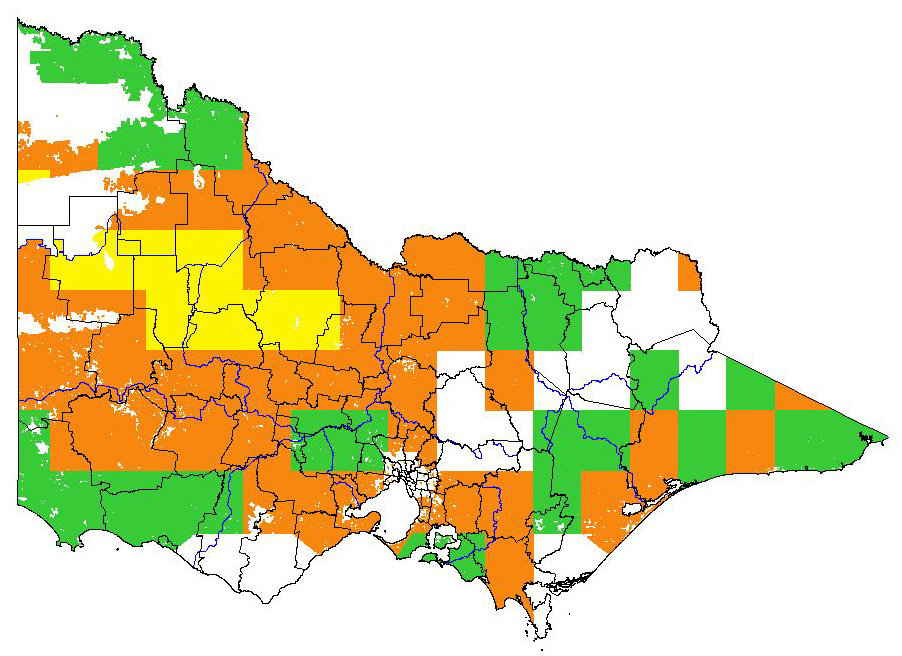
|
Impact
QUESTION | COMMENTS | RATING | CONFIDENCE |
| Social | |||
| 1. Restrict human access? | |||
| 2. Reduce tourism? | |||
| 3. Injurious to people? | |||
| 4. Damage to cultural sites? | |||
| Abiotic | |||
| 5. Impact flow? | |||
| 6. Impact water quality? | |||
| 7. Increase soil erosion? | |||
| 8. Reduce biomass? | |||
| 9. Change fire regime? | |||
| Community Habitat | |||
| 10. Impact on composition (a) high value EVC | |||
| (b) medium value EVC | |||
| (c) low value EVC | |||
| 11. Impact on structure? | |||
| 12. Effect on threatened flora? | |||
| Fauna | |||
| 13. Effect on threatened fauna? | |||
| 14. Effect on non-threatened fauna? | |||
| 15. Benefits fauna? | |||
| 16. Injurious to fauna? | |||
| Pest Animal | |||
| 17. Food source to pests? | |||
| 18. Provides harbor? | |||
| Agriculture | |||
| 19. Impact yield? | |||
| 20. Impact quality? | |||
| 21. Affect land value? | |||
| 22. Change land use? | |||
| 23. Increase harvest costs? | |||
| 24. Disease host/vector? |
Invasive
QUESTION | COMMENTS | RATING | CONFIDENCE |
| Establishment | |||
| 1. Germination requirements? | |||
| 2. Establishment requirements? | |||
| 3. How much disturbance is required? | |||
| Growth/Competitive | |||
| 4. Life form? | |||
| 5. Allelopathic properties? | |||
| 6. Tolerates herb pressure? | |||
| 7. Normal growth rate? | |||
| 8. Stress tolerance to frost, drought, w/logg, sal. etc? | |||
| Reproduction | |||
| 9. Reproductive system | |||
| 10. Number of propagules produced? | |||
| 11. Propagule longevity? | |||
| 12. Reproductive period? | |||
| 13. Time to reproductive maturity? | |||
| Dispersal | |||
| 14. Number of mechanisms? | |||
| 15. How far do they disperse? |
References
Al-Qura’n S. (2005) Mini-review: Ethnobotanical survey of folk toxic plants in southern part of Jordan. Toxicon. 46: 119-129.
A. Vogel: Plant Encyclopaedia (AVPE) (undated) Bryonia cretica L. ssp. dioica (JACQ.) TUTIN (White Bryony).
Biosecurity NZ (New Zealand) (2009). White bryony. http://www.biosecurity.govt.nz/pests/white-bryony (verified 11/11/2009).
Cooper MR and Johnson AW. (1984) Poisonous Plants in Britain and their Effects on Animals and Man. Ministry of Agriculture, Fisheries and Food. Her Majesty’s Stationary Office, London.
Environment Waikato Regional Council (EWRC) (1999-2007) Part 2- Pest management programmes: 5 Pest plants; 5.2 Eradication pest plants, 5.2.15 White bryony (Bryonia cretica) Available at: http://www.ew.govt.nz/Policy-and-plans/Regional-Pest-Management-Strategy/Regional-Pest-Management-Strategy-2008-2013/Part-2/5-Pest-plants/52-Eradication-pest-plants/5215-White-bryony-Bryonia-cretica/ (verified 10/11/2009).
Flowers In Israel (FII) (undated). Bryonia cretica, Cretan Bryony. Available at: http://www.flowersinisrael.com/Bryoniacretica_page.htm (verified 11/11/2009).
Froude V.A. (2002). Biological control options for invasive weeds of New Zealand protected areas. Department of Conservation, Wellington. Available at:
http://www.doc.govt.nz/upload/documents/science-and-technical/sfc199.pdf (verified 19/11/2009).
Grieve M. (1994) A Modern Herbal. Tiger Books, London.
Horizons Regional Council (HRC) (2003) White bryony. Available at: http://www.horizons.govt.nz/Images/Publications/PestPlantAnimal/White%20bryony.pdf (verified 11/11/09).
Navarro L. and Guitian J. (2003) Seed germination and seedling survival of two threatened endemic species of the northwest Iberian peninsula. Biological Conservation. 109: 313- 320.
Plants for a Future (PFAF) (undated) Bryonia dioica- Jacq. Red Bryony. Available at: http://www.pfaf.org/database/plants.php?Bryonia+dioica (verifed 11/11/2009).
Timmins S.M. and Braithwaite H. (no date) Early detection of invasive weeds on islands. In Veitch C.R. and Clout M.N. (eds.). Turning the tide: the eradication of invasive species.
IUCN SSN Invasive Specialist Group. IUCN, Gland, Switzerland and Cambridge, UK.
Tree of Life (undated). Bryonia Cretica. http://thetreeoflifeclinic.co.uk/bryonia-herb6.html (verified 11/11/2009).
Global present distribution data references
Australian National Herbarium (ANH) (2009) Australia’s Virtual Herbarium, Australian National Herbarium, Centre for Plant Diversity and Research, Available at http://www.anbg.gov.au/avh/ (verified 18/11/2009).
Global Biodiversity Information Facility (GBIF) (2009) Global biodiversity information facility, Available at http://www.gbif.org/ (verified 20/08/2009).
Integrated Taxonomic Information System. (2009) Available at http://www.itis.gov/ (verified 20/08/2009).
Missouri Botanical Gardens (MBG) (2009) w3TROPICOS, Missouri Botanical Gardens Database, Available at http://mobot.mobot.org/W3T/Search/vast.html (verified 20/08/2009).
United States Department of Agriculture. Agricultural Research Service, National Genetic Resources Program. Germplasm Resources Information Network - (GRIN) [Online Database]. Taxonomy Query. (2009) Available at http://www.ars-grin.gov/cgi-bin/npgs/html/taxgenform.pl (verified 20/08/2009).
Feedback
Do you have additional information about this plant that will improve the quality of the assessment?
If so, we would value your contribution. Click on the link to go to the feedback form.
