Victorian Resources Online (archived)
Dargo (Do)
|
|
Geology
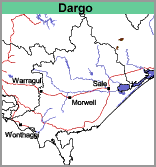
Ordovician-silurian granodiorite. The boundary on the soil map was established on the basis of the geological map and contour information. The underlying rocks are similar to those underlying the Timbarra map unit but the topography is of lower relief.
Landform
Undulating to rolling hills.
Soils
Three soil profiles have been examined on this mapping unit by Aldrick et al. (1992). Decomposing rock (granite) was encountered less than 1 m from the surface and all surface soils were dark brown sandy loams with a pH of around 6.0. The subsoils, which occurred between 25 and 50 cm, were red or brown medium clays or sandy clays with pH’s around 6.5 to 7.0. All soils were non-sodic and all have a relatively high cation exchange capacity.
Land Management
The soils on this unit are particularly prone to gully erosion on the valley floors and on steep upper slopes. The upper slopes are also prone to sheet and rill erosion if overgrazed. The surface soils are naturally high in potassium, but phosphorus is generally low. As the pH is above 6.0 lime additions are unnecessary.
Land Use
The area is mostly cleared and is mainly grazed by cattle and sheep on improved and native pastures.
