Victorian Resources Online (archived)
GP33
| Australian Soil Classification: SODOSOL. | Great Soil Group: soloth. |
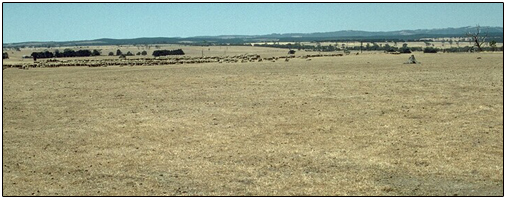 GP33 Landscape |
Soil Profile Morphology:
| Surface Soil | |||
A1 | 0-20 cm | Brown (10YR4/3); sandy loam; firm consistence dry; pH 5.6: | 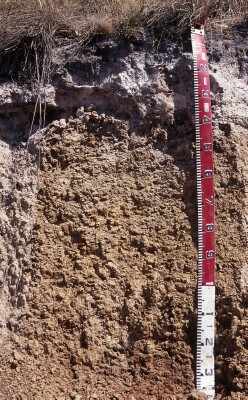 GP33 profile |
A21 | 20-35 cm | Pinkish brown (7.5YR7/4) conspicuously bleached (10YR8/2d); sandy loam; iron nodules (15%) (5-10 mm in size) and quartz fragments (2-5 mm in size) common; pH 5.6; smooth change to: | |
NOTE: In some areas there is a discontinuous A22 above the subsoil. Light yellowish brown (10YR6/4) with brownish yellow (10YR6/6) mottles; sandy clay loam; strong consistence dry; pH 6.3. | |||
| Subsoil | |||
B21 | 35-70 cm | Yellowish brown (10YR5/4) with yellowish brown (10YR5/8) mottles; medium clay; moderate coarse blocky, breaking to moderate medium blocky structure; very strong consistence dry; contains a few (5%) iron nodules with quartz; pH 5.9: | |
B22 | 70+ cm | Brownish yellow (10YR6/8) with light brownish grey (10YR6/2) mottles; medium clay; moderate coarse blocky structure; contains a few (5-10%) iron and quartz nodules (2-5 mm in size); pH 6.0. | |
Key Profile Features:
- Strong texture contrast between surface (A) horizon (13% clay) and strongly sodic subsoil (B21) horizon (54% clay).
- Conspicuously bleached subsurface (A2) horizon.
Horizon | pH | Salinity Rating | ||
Surface (A1 horizon) | moderately acid | very low | non-sodic | none |
Subsoil (B21 horizon) | moderately acid | very low | strongly sodic | none1 |
Deeper subsoil (at 90 cm) | moderately acid | very low | __ | slight1 |
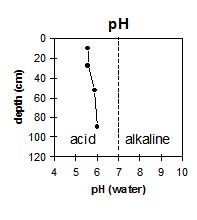 The profile is moderately acid throughout. | 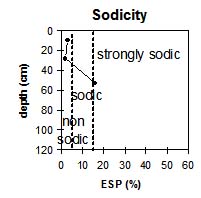 The surface soil is non-sodic. The subsoil is strongly sodic. | 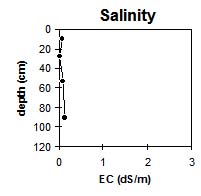 The salinity rating is very low throughout the profile. | 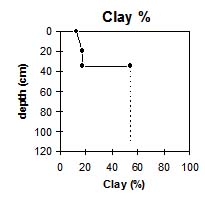 The clay content increases significantly at the A/B horizon interface. |
Horizon | Horizon Depth (cm) | pH (water) | pH (CaCl2) | EC 1:5 | Exchangeable Cations | |||
Ca | Mg | K | Na | |||||
meq/100g | ||||||||
A1 | 0-20 | 5.6 | 4.6 | 0.08 | 1.1 | 1.4 | 0.41 | 0.29 |
A21 | 20-35 | 5.6 | 4.6 | <0.05 | 0.71 | 1.7 | 0.26 | 0.17 |
B21 | 35-70 | 5.9 | 4.7 | 0.1 | 0.82 | 7.9 | 0.15 | 1.6 |
B22 | 70+ | 6 | 4.7 | 0.14 | ||||
Horizon | Horizon Depth (cm) | Exchangeable Aluminium mg/kg | Exchangeable Acidity meq/100g | Wilting Point pF4.2 | Coarse Sand (0.2-2.0 mm) | Fine Sand (0.02-0.2 mm) | Silt (0.002-0.02 mm) | Clay (<0.002 mm) |
A1 | 0-20 | 15 | 7.8 | 6 | 31 | 35 | 19 | 13 |
A21 | 20-35 | 20 | 5.4 | 6 | 28 | 36 | 19 | 17 |
B21 | 35-70 | 19 | 18 | 16 | 9 | 54 | ||
B22 | 70+ | 19 |
Management Considerations:
Surface (A) Horizons
- The surface (A1) horizon has a high fine sand content (35%). Soils such as these rely to a large extent on organic matter for maintaining aggregation. The levels of organic carbon measured at the pit site (which may or may not be representative of the whole paddock) is moderate. Practices such as residue retention, minimum tillage and including pasture rotations could be utilised if cropping takes place in order to build up organic matter, improve aggregation as well as assist in the low water holding capacity and reduce erosion risk.
- The inherent fertility is very low and planting legumes may help to increase nutrients within the surface layers.
- The surface (A1) horizon is non-sodic with no dispersion. However, the low exchangeable calcium to magnesium level (0.8) and the presence of slight dispersion after remoulding indicates that structural degradation (e.g. surface sealing, increased cloddiness) may occur if the soil is cultivated or overstocked in a moist to wet condition. Also, raindrop action on bare surface soil may also promote dispersion. Surface cover should be maintained to protect against raindrop damage.
- The low wilting point value (6.2) of the surface (A1) horizon indicates that plants will be able to utilise very light rains when the soil is dry. However, due to the low water storage capacity, plants will soon suffer moisture stress unless further rain falls occur.
- The surface (A1) horizon is moderately acid. Acid soils can have higher then normal aluminium and manganese levels which are toxic to plants. If aluminium toxicity is only found in the surface and not the subsoil, then it may be economic to add lime to raise the pH and decrease the toxicity. However, it would be necessary to collect soil from the whole paddock as well as at depth and do the aluminium test again to ascertain accurate levels.
- The presence of conspicuous bleaching in the subsurface (A21) horizon indicates that periodic waterlogging occurs above the slowly permeable sodic subsoil. The discontinuous A22 horizon has a strong consistence, which would make it tougher for young roots to penetrate.
- The coarsely structured upper subsoil is strongly sodic and has a low exchangeable calcium to magnesium ratio (i.e. 0.1). Strong dispersion occurs after remoulding, which indicates that subsoil permeability may be restricted. The dispersive subsoil will be highly erodible to water when exposed. Maintaining a protective cover of surface soil and vegetation is important, especially on sloping land. The subsoil is mottled throughout which also indicates subsoil drainage is imperfect.
