Victorian Resources Online (archived)
GP37
| Location: Nambrok West. | Australian Soil Classification: Vertic, Mottled-Mesonatric, Brown SODOSOL. |
| Great Soil Group: solodic. | Geology: Pleistocene and recent sediments. |
| General Landscape Description: Level plain. | Mapping Unit: Winnindoo. |
| Site Description: Pasture paddock. | |
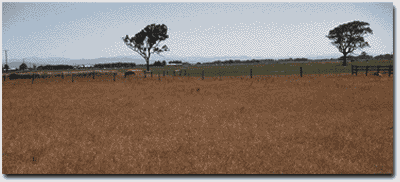 Site GP37 Landscape |
Soil Profile Morphology:
Surface Soil
| A1 | 0-10 cm | Dark brown (10YR3/3); loam, fine sandy; firm consistence dry; pH 5.7; clear change to: | 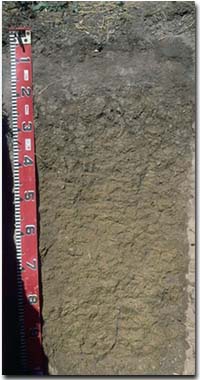 Site GP37 Profile |
| A2 | 10-20 cm | Brown (10YR4/3) sporadically bleached (10YR6/2d) with brownish yellow (10YR6/6) mottles; fine sandy loam; very strong consistence dry; pH 5.2; abrupt change to: | |
| Subsoil | |||
| B21 | 20-50 cm | Yellowish brown (10YR5/4) with brownish yellow (10YR6/6 and 6/8) mottles; medium clay; moderate coarse subangular blocky, parting to weak blocky structure; very strong consistence dry; contains dark organic matter stains on ped faces; pH 7.3; clear change to: | |
| B22 | 50-90 cm | Yellowish brown (10YR5/4) with brownish yellow (10YR6/6) mottles; medium clay; pH 8.5; gradual change to: | |
| B23 | 90+ cm | Brownish yellow (10YR6/6); strong coarse blocky, parting to strong medium blocky structure; shiny faced peds; contains some ironstone nodules (2-4 mm in size); slickensides are present; pH 8.8. |
Key Profile Features:
- Strong texture contrast between surface (A) horizon (14% clay) and strongly sodic subsoil (B21) horizon (35% clay).
- Vertic properties (i.e. significant shrink-swell characteristics) in the deeper subsoil.
Soil Profile Characteristics:
Horizon | pH | Salinity Rating | ||
Surface (A1 horizon) | Moderately Acid | Low | Non-Sodic | None1 |
Subsoil (B21 horizon) | Slightly Alkaline | Low | Strongly Sodic | Complete |
Deeper subsoil (at1 m) | Strongly Alkaline | Moderate | - | Complete |
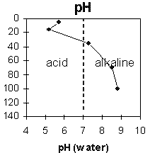 | The surface is moderately acid. The subsoil is slightly alkaline becoming strongly alkaline at 80 cm. | 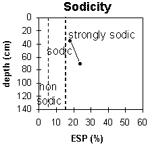 | The surface is non-sodic. The subsoil is strongly sodic. |
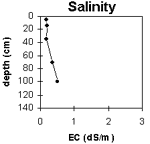 | The surface has a low salinity level. The subsoil becomes moderate at 1 metre. | 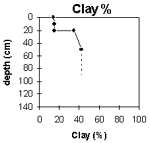 | The clay content increases significantly at the A/B horizon interface. |
Horizon | Horizon Depth (cm) | pH (water) | pH (CaCl2) | EC 1:5 | NaCl | Exchangeable Cations | |||
Ca | Mg | K | Na | ||||||
meq/100g | |||||||||
A1 | 0-10 | 5.7 | 4.9 | 0.18 | 2.5 | 1.9 | 1.4 | 0.36 | |
A2 | 10-20 | 5.2 | 4.6 | 0.21 | 1.4 | 1.5 | 0.72 | 0.42 | |
B21 | 20-50 | 7.3 | 6.3 | 0.18 | 2.3 | 7.1 | 0.56 | 2.1 | |
B22 | 50-90 | 8.5 | 7.4 | 0.35 | 0.06 | 1.8 | 7.6 | 0.6 | 3.1 |
B23 | 90+ | 8.8 | 7.9 | 0.51 | 0.1 | ||||
Horizon | Horizon Depth (cm) | Exchangeable Aluminium mg/kg | Exchangeable Acidity meq/100g | Field Capacity pF2.5 | Wilting Point pF4.2 | Coarse Sand (0.2-2.0 mm) | Fine Sand (0.02-0.2 mm) | Silt (0.002-0.02 mm) | Clay (<0.002 mm) |
A1 | 0-10 | 7 | 16 | 46 | 19 | 14 | |||
A2 | 10-20 | <10 | 6.5 | 5 | 14 | 48 | 21 | 15 | |
B21 | 20-50 | 13 | 13 | 31 | 7 | 35 | |||
B22 | 50-90 | 15 | 9 | 30 | 18 | 42 | |||
B23 | 90+ |
Management Considerations:
Whole Profile
- Plant Available Water Capacity (PAWC) is considered to be low. Effective rooting depth is most likely restricted to just the surface horizons. The dense and coarsely structured subsoil will significantly restrict the effective rooting depth.
- The surface (A1) horizon has a high silt content (46%). Soils such as these rely to a large extent on organic matter for maintaining aggregation and soil fertility.
- The nutrient holding capacity of the surface soil is low (based on the sum of the exchangeable basic cations). Organic matter is also important for soils such as these for maintaining soil fertility.
- The surface (A1) horizon is non-sodic and does not disperse unless remoulded. The occurrence of slight dispersion after remoulding indicates that some structural degradation (e.g. surface sealing, increased cloddiness) may occur if the soil is cultivated or overstocked in a moist to wet condition. Also, raindrop action on bare surface soil may also promote dispersion. Surface cover should be maintained to protect against raindrop damage.
- The low wilting point value (7%) of the surface (A1) horizon indicates that plants will be able to utilise very light rains when the soil is dry. However, due to the low water storage capacity, plants will soon suffer moisture stress unless further rainfall occurs.
- The presence of sporadic bleaching in the subsurface (A2) horizon indicates that periodic waterlogging occurs above the more slowly permeable subsoil.
- The dense and coarsely structured upper subsoil is strongly sodic and disperses completely. Root and water movement are likely to be significantly restricted due to these conditions. Deep ripping (with gypsum application) has been advocated by some researchers as an effective ameliorative technique. This may not be an economical alternative.
- The subsoil becomes moderately saline at about 1 metre depth which is only likely to restrict the growth of deep rooted very salt sensitive plant species.
- The subsoil displays vertic properties (i.e. slickensides) which indicates that significant shrinking and swelling occurs with wetting and drying cycles. This may disturb the roots of some plant species. The shrinking and swelling may also have some engineering implications (e.g. disturbance to fence lines).
