Victorian Resources Online (archived)
Site LS1
Location: Kinimakatka
Australian Soil Classification: Calcic, Mottled-Subnatric, Red SODOSOL
Northcote Factual Key: Dr 3.23
Great Soil Group: red-brown earth (sodic)
General Landscape Description: Upper slope on the eastern side of a north-south trending gently undulating rise.
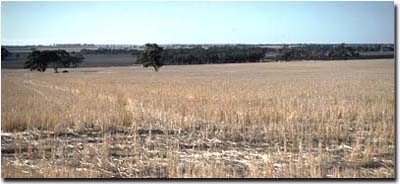 LS1 Landscape |
Soil Profile Morphology:
Surface Soil
| A1 | 0-10 cm | Dark brown (7.5YR3/4); sandy clay loam; weakly structured; weak consistence dry; pH 6.0: | 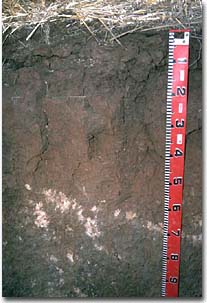 LS1 Profile |
| A2 | 10-15 cm | Brown (7.5YR4/4); sandy clay loam; weakly structured but tends to fracture into platy like fragments; very strong consistence dry (possible cultivation pan); pH 6.5; sharp boundary change to: | |
| Subsoil | |||
| B21 | 15-25 cm | Reddish brown (5YR4/4) and dark reddish grey (5YR4/2); heavy clay; strong very coarse prismatic structure; very strong consistence dry; pH 7.3: | |
| B22 | 25-60 cm | Yellowish red (5YR5/8) with dark reddish grey (5YR4/2) mottles; heavy clay; strong very coarse prismatic, parting to moderate blocky structure; pH 9.2: | |
| B23 | 60-100 cm | Yellowish brown (10YR5/4) with slight red mottles; medium heavy clay; moderate medium prismatic (finer than above) parting to moderate medium blocky structure; contains a common (10 - 20%) amount of soft and nodular carbonate in pockets and very few (2 %) ironstone nodules; pH 9.4. | |
- Strong texture contrast between surface (A) horizons and heavy clay (B) horizons.
Soil Profile Characteristics:
| - | pH | Salinity | ||
Surface (A1 horizon) | Moderately Acid | Very low | Non-Sodic | None |
Subsoil (B21 horizon) | Slightly Alkaline | Very low | Sodic | Slight |
Deeper Subsoil (at 1 metre) | Very Strongly Alkaline | High | Strongly Sodic | Moderate- Strong |
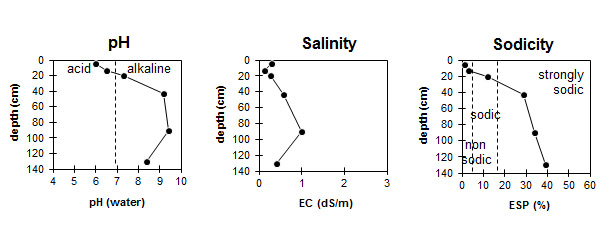
| The surface soil is moderately acid. The subsoil is slightly alkaline becoming very strongly alkaline with depth. | The salinity rating is very low in the surface and upper subsoil becoming high with depth. | The surface is non-sodic. The subsoil is sodic becoming strongly sodic with depth.. |
Management Considerations:
Surface (A) Horizons
- The surface soil does not slake or disperse when immersed in water. This is a favourable condition which can be preserved by maintaining organic matter levels which assists in reducing slaking.
- The surface horizon has a moderate nutrient status and adequate organic carbon and nitrogen levels.
- The subsurface (A2) horizon may be prone to developing a cultivation pan which will inhibit root growth and restrict water movement. This could develop if the soil is cultivated in a moist condition (as indicated by dispersion of the A2 horizon that occurs after remoulding).
- The top of the subsoil is sodic and slightly dispersive which may limit water and root movement down the profile. The deeper subsoil becomes increasingly sodic and dispersive. The addition of gypsum with deep ripping has been advocated by some researchers as an ameliorative technique for sodic subsoils. A test strip could be used to assess likely benefits.
- Gypsum used successfully.
- Wheat/chickpea/pasture rotation used.
- Good wheat yields achieved.
- Superphosphate applied.
- Gypsum application together with ripping to approximately 20 - 25 cm depth has been beneficial on similar soils at Winiam.
