Victorian Resources Online (archived)
Site LS16
Location: Perenna
Australian Soil Classification: Epicalcareous (& Hypercalcic)-Epihypersodic, Epipedal, Grey VERTOSOL
Northcote Factual Key: Ug 5.21
Great Soil Group: grey clay
General Landscape Description: Gently undulating plain. This site occurs in a low-lying position.
Native Vegetation: Mallee vegetation occurs in its natural state.
 LS16 Landscape |
Soil Profile Morphology:
Surface Soil
| A1 | 0-10 cm | Very dark grey (10YR3/1); light medium clay; moderate coarse blocky structure; strong consistence dry; pH 8.4: | 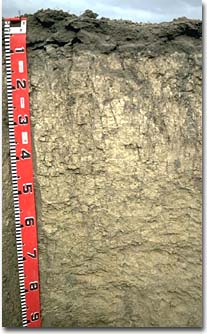 LS16 Profile |
| Subsoil | |||
| B21k | 10-30 cm | Light brownish grey (2.5Y6/2); medium clay; strong coarse prismatic, parting to moderate coarse blocky structure; strong consistence dry; contains a common (10-20 %) amount of soft calcium carbonate; pH 9.1: | |
| B22k | 30-50 cm | Light grey (5Y7/2); medium clay; strong medium prismatic, parting to moderate medium blocky structure; strong consistence dry; contains a common (10-20 %) amount of soft calcium carbonate; pH 9.7: | |
| B23 | 50-150 cm | Light grey (5Y7/2) with yellow (10YR7/6) diffuse mottles; medium heavy clay; parts to moderate fine polyhedral structure; pH 9.5: | |
| B24 | 150+ cm | Light grey (5Y7/2) with brownish yellow (10YR6/8) mottles; heavy clay; moderate lenticular structure; firm consistence moist; contains large sand pockets; pH 9.3. | |
Key Profile Features:
- Clay texture throughout profile.
- Strong vertic properties (as evidenced by lenticular structure).
- Zone of maximum soft carbonate accumulation occurs in the B21 horizon from 10 cm in depth (ie. hypercalcic).
Soil Profile Characteristics:
pH | Salinity | |||
Surface (A1 horizon) | Moderately Alkaline | Low | Non-Sodic | Slaking, No Dispersion |
Subsoil (B21 horizon) | Very Strongly Alkaline | Low | Non-Sodic | None |
Deeper Subsoil (at 1 metre) | Very Strongly Alkaline | Medium-High | Strongly Sodic | None1 |
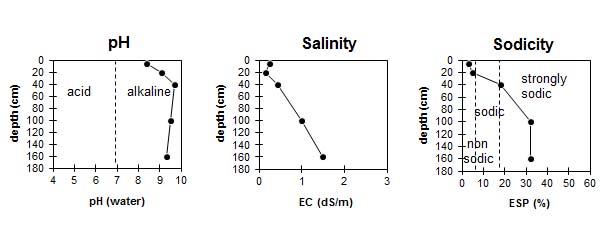
| The surface soil is moderately alkaline. The subsoil is very strongly alkaline throughout. | The salinity rating is low in the surface and upper subsoil becoming high with depth. | The surface and upper subsoil is non-sodic. The subsoil is becomes strongly sodic at about 40 cm depth. |
Management Considerations:
Surface (A) Horizon
- The inherent fertility (based on the sum of the basic exchangeable cations) of the surface soil is high.
- Surface horizon aggregates slake when rapidly wet which may cause surface crusting problems. Maintaining organic matter levels will assist in minimising slaking.
- Tillage or excessive trafficking of clay soils should be avoided if the soil is in a moist to wet condition (ie. wetter than the plastic limit). At such moisture conditions, tillage or excessive trafficking can result in structural damage (eg. compaction, smearing) occurring. Ideally, tillage should take place when the soil is drier than the plastic limit down to at least the depth of tillage.
Subsoil (B) Horizons
- The upper subsoil is non-sodic and does not disperse. The subsoil is, however, strongly sodic below 30 cm depth. This may reduce water permeability and restrict root movement below this depth.
- The very strongly alkaline subsoil indicates that nutrients such as iron, manganese, copper and zinc may be poorly available to plants.
- Subsoil soluble salt levels may restrict the growth of salt sensitive species from a depth of 50 cm in the profile.
Comments from Landholder:
- Barley/field peas/chickpeas rotation has been used.
- Nitrogen has been applied.
- Waterlogging problems do not occur.
Profile Described By: Mark Imhof, John Martin, David Rees, Sonia Thompson (May 1994).
