Victorian Resources Online (archived)
Archived content — This page contains material from the Victorian Resources Online (VRO) website. It is no longer maintained and is provided for reference only. This content is hosted by CeRDI and is not endorsed by Agriculture Victoria.
Sitemap
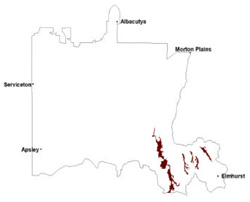
11. Yellow and brown gradational and texture contrast soils/Dissected Uplands: Terraces and floodplains
|
This soil has developed on mainly Quaternary alluvial and colluvial unconsolidated material in the Western Uplands.
The surface soil is usually a brown loamy sand, which is massive to weakly structured. It overlies a light yellowish brown conspicuously bleached loamy sand to sandy loam subsurface horizon which has no structure (massive).
There is a gradual change to a (brown) mottled light yellowish brown (occasionally yellowish red) heavy sandy loam which is massive. This grades into a silty light clay, which is strongly structured and grades into lighter textured weathered unconsolidated parent material (alluvium). The depth is about 130 cm or more with variable depths of the surface horizons, generally 5-10 cm for the surface and 20-50cm for the subsurface, occasionally deeper.
Notable features include:
- Gradational or texture contrast change in clay percentage with depth.
- Variable depth of lighter upper soil with low nutrient capacity variable rooting depth and low water holding capacity.
- Weakly developed structure.
- These features make these soils vulnerable to sheet and rill erosion, particularly on sloping terrain given the lighter surface soils with variable organic matter content.
|  |
Soil Sites
Site code | Soil-landform unit | Component | ASC | FK | 1:100 000 mapsheet |
| WLRA66 | Mount Cole Creek | Terrace | Bleached-Sodic, Yellow Kandosol | Gn2.96 | T7523 - Beaufort |
| WLRA63 | Mount Cole Creek | Plain | Bleached-Sodic, Red Kandosol | Dr2.42 / Gn3.19 | T7423 - Ararat |
