Victorian Resources Online (archived)
Archived content — This page contains material from the Victorian Resources Online (VRO) website. It is no longer maintained and is provided for reference only. This content is hosted by CeRDI and is not endorsed by Agriculture Victoria.
Sitemap
38. Sodic brown, yellow and grey texture contrast soils/Ridges with sand and flats: Low remnant ridge tops with aeolian sands and oriented swales
|
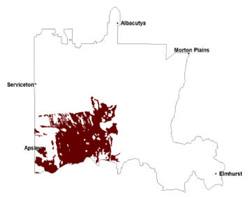
These soils have developed on Quaternary unconsolidated material, generally of riverine, aeolian and lacustrine origin in the North West Dunefields and Plains, south of the Little Desert. The soil has a slightly acidic surface with a slightly acidic to slightly alkaline upper subsoil becoming strongly alkaline below. Variations may be influenced by climate variation.
The surface soil is usually a dark brown loamy sand which is apedal (massive or sandy) to weakly structured. It overlies a pale brown subsurface horizon which is bleached, apedal (massive or sandy) occasionally with ferruginous nodules (buckshot). There is a sharp/abrupt change to a brown to strong brown (occasionally yellow) medium heavy clay subsoil horizon. This is strongly structured (with coarse (columnar) to medium sized peds) and sodic. This overlies a pink, medium clay (fine sandy) horizon with a faint mottle, moderately structured (coarse sized peds), sodic and with variable free calcium carbonate. This soil grades into a reddish yellow mediuim clay, which is mottled before grading into weathered regolith (often sandstone). The profile depth is about 130 cm or more (at least 2 m) with variable depths of the surface horizons, generally 10 cm (5-20 cm) for the surface and 15 cm (5-30cm) for the subsurface, often deeper.
Notable features include:
- Texture contrast soil, subsoil is sodic.
- Variable surface condition (generally soft, occasionally hardsetting) with sandy surfaces.
- Strong consistence (strength) contrast between the lighter shallow surface and subsurface soil and heavy subsoil.
- Free (visible) calcium carbonate is common to dominant in mid subsoil.
- Subsoil mottling generally absent in drier environments, apart from transition to weathered regolith at depth.
|  |
Soil Sites
Site code | Soil-landform unit | Component | ASC | FK | 1:100 000 mapsheet |
| LSWW11 | Kybybolite plains | Hillslope | Hypercalcic, Mottled-Hypernatric, Brown Sodosol | Db4.43 | T7124 - Goroke |
| LSWW17 | Kowree undulating sand plains and ridges | Riseslope | Calcic, Mottled-Mesonatric, Yellow Sodosol | Dy5.43 | T7123 - Edenhope |
| LSWW13 | Ullswater plains and rises | Riseslope | Calcic, Mottled-Mesonatric, Grey Sodosol | Dg4.43 | T7124 - Goroke |
