Victorian Resources Online (archived)
LP50
| Property: LP50 Mitiamo | Group: Pine Grove Farm Advance |
| Australian Soil Classification: Epicalcareous-Endohypersodic, Epipedal, Red VERTOSOL, intermixed with a Black VERTOSOL | Northcote Factual Key: Ug 5.3 |
| Great Soil Group: brown clay | |
| General Landscape Description: Edge of an old alluvial plain (treeless) near Mount Terrick Terrick. This site occurs in a slight depression. Gilgai microrelief existed prior to clearing. | |
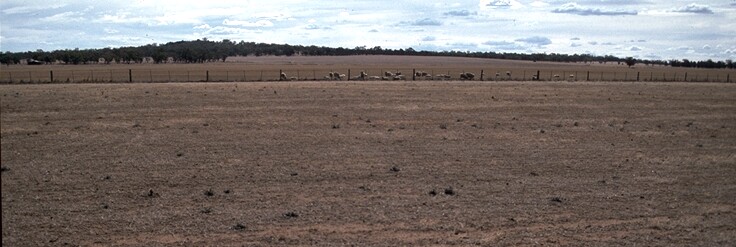 LP50 Landscape |
Soil Profile Morphology
Surface Soil
| A1 | 0-10 cm | Dark reddish brown (5YR3/3); light medium clay; surface flake; moderate fine to medium polyhedral structure; very firm consistence dry, friable moist; pH 8.3; sharp change to: | 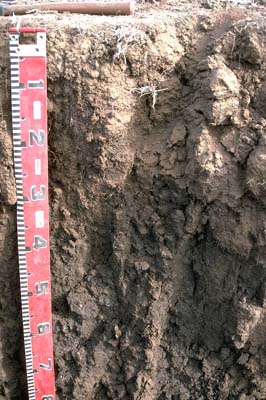 LP50 profile |
| Subsoil | |||
| B21 | 10-35 cm | Yellowish red (5YR5/6); medium clay; cracking occurs to the base of this horizon; weak coarse blocky structure; strong consistence dry; pH 8.5; gradual and wavy change to: | |
| B22k | 35-100 cm | Reddish brown (5YR4/4); medium heavy clay; moderate prismatic, parting to coarse blocky structure (with smooth-faced peds); very strong consistence dry; fine-earth carbonate common (10-15 %); pH 9.3; gradual change to: | |
| B23 | 100 cm+ | Yellowish red (5YR5/6); heavy clay; moderate coarse blocky structure; strong consistence moist; pH 9.5. | |
NOTE: The subsoil (B21 horizon) colour varies at this site. It can also be greyish brown (10YR3/2) and extend to a depth of about 80 cm. | |||
Key Profile Features
- Clay texture throughout the profile.
- Strong profile cracking during wetting and drying cycles
Key Profile Characteristics
pH | Salinity Rating | |||
Surface (A1 horizon) | moderately alkaline | very low | non-sodic | none |
Subsoil (B21 horizon) | moderately alkaline | very low | non-sodic | none |
Deeper subsoil (at 1 m) | extremely alkaline | low-medium | strongly sodic | moderate |
LP50a
Horizon | Horizon Depth | pH (water) | EC 1:5 | NaCl | Exchangeable Cations | |||
Ca | Mg | K | Na | |||||
meq/100g | ||||||||
A1 | 0-10 | 8.3 | 0.15 | 28 | 3.9 | 2.2 | 0.2 | |
B21 | 10-35 | 8.5 | 0.12 | 24 | 7.4 | 1.2 | 0.9 | |
B22k | 35-100 | 9.3 | 0.29 | <0.05 | 14 | 15 | 0.9 | 4.1 |
B23 | 100+ | 9.5 | 0.78 | 0.09 | 6.2 | 18 | 1.3 | 10 |
Horizon | Horizon Depth | Ex Al mg/kg | Ex Ac meq/100g | Field pF2.5 | Wilting Point pF4.2 | Coarse Sand (0.2-2.0mm) | Fine Sand (0.02-0.2mm) | Silt (0.002-0.02mm) | Clay (<0.002mm) |
A1 | 0-10 | 33.5 | 25.4 | 7 | 22 | 10 | 52 | ||
B21 | 10-35 | 42.3 | 32.2 | 7 | 17 | 7 | 61 | ||
B22k | 35-100 | 49.1 | 37 | 5 | 12 | 6 | 57 | ||
B23 | 100+ |
Horizon | Horizon Depth | pH (water) | EC dS/m | NaCl | Exchangeable Cations | |||
Ca | Mg | K | Na | |||||
Meq/100g | ||||||||
B21 | 10-40 | 8.6 | 0.12 | 26 | 5.9 | 1 | 0.7 | |
B22 | 40-80 | 9.2 | 0.3 | <0.05 | 18 | 10 | 0.8 | 5.1 |
Horizon | Horizon Depth | Ex Al mg/kg | Ex Ac meq/100g | Field pF2.5 | Wilting Point pF4.2 | Coarse Sand (0.2-2.0mm) | Fine Sand (0.02-0.2mm) | Silt (0.002-0.02mm) | Clay (<0.002mm) |
B21 | 10-40 | 40.5 | 30.7 | ||||||
B22 | 40-80 |
Management Considerations:
- In general, management strategies for all soils should aim to increase organic matter levels in the surface soil; minimise the degradation of soil aggregates and porosity; promote the development of stable biopores; improve the calcium status of the ion exchange complex (particularly when sodium is a significant part – i.e. sodic), and break up any hardpans. Less frequent tillage; using less aggressive implements, and working the soil at optimum moisture conditions can all assist in maintaining soil aggregation and porosity as well as reducing the breakdown of organic matter. Practices such as residue retention, minimum tillage and including pasture rotations could be utilised if cropping takes place in order to build up organic matter, reduce erosion risk and increase fertility.
- Plant available water capacity (PAWC) is estimated to be medium (estimated at 100-120 mm) for this profile - based on the laboratory data available.
Surface (A) Horizons
- The surface horizon has a very high overall nutrient status.
- When the soil is dry, heavy rains will move down soil cracks. This rapid recharge can be valuable for the survival of plants near wilting. When wet, the soil will swell and further infiltration of water will be relatively slow.
- Tillage of cracking clay soils should be avoided if the soil is wet (i.e. wetter than the plastic limit). At such moisture conditions, tillage or excessive trafficking or overstocking could result in structural damage (e.g. compaction, smearing) occurring. Ideally, tillage and trafficking should take place on cracking clay soils when the soil is drier than the plastic limit, down to at least the tillage depth.
- The high wilting point (25%) value indicates that plants will not be able to fully utilise light rains falling on relatively dry soil, as there will be insufficient moisture to wet the soil above the wilting point. This may result in moisture stress to plants in a dry spring.
Subsoil (B) Horizons
- The subsoil becomes sodic below 35 cm but does not disperse unless it is remoulded.
- Soluble salts are low for the top metre of the profile.
- Below 35 cm depth the profile becomes very strongly alkaline, indicating that certain nutrients (e.g. phosphorus, iron, manganese and zinc) may become poorly available to plants.
Landholder Comments:
- Gypsum has never been used.
- This paddock yields higher than Site LP51.
- Wheat is cropped here.
Notes:
Profile described by Mark Imhof, Paul Rampant and Karen de Plater (1/3/95)
