Victorian Resources Online (archived)
Australian Sweet-grass
Back | Salinity Indicator Plants Home | Common name home | Scientific name home | Photo Gallery | Glossary
| Australian Sweet-grass photos | Family Name: Grass (Poaceae syn. Gramineae) |
| Scientific Name: | Glyceria australis | 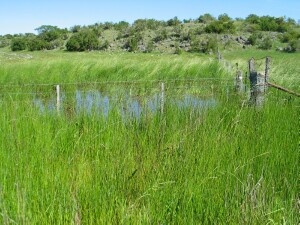 Australian Sweet-grass growing in shallow water Photo: A J Brown | |||||
Status: | Native to southern Australia. | ||||||
Plant Description: | Shortly rhizomatous perennial grass to 1 m high with hairless leaves to 50 cm long and 8 mm wide. Leaf sheaths are tubular and non-split (as in most grasses) except near the junction of leaf blade and stem. Flower-heads are slender open panicles, 20-50 cm long. Spikelets 5-12 flowered and 10-30 mm long. Each floret is awnless and noticeably 7-nerved. | ||||||
Habitat: | Scattered across temperate Victoria, on swamps, shallow lakes and the edges of streams.
| ||||||
Comments: | Similar in general appearance, growth habit and habitat as Common Swamp Wallaby-grass (Amphibromus nervosus) but immediately obvious due to the lack of floret awns. Has similar spikelets to Australian Saltmarsh-grass (Puccinellia stricta) but distinguished by its closed leaf-sheath and is never found in saline environments. | ||||||
 Closed sheath (showing septum) of Australian Sweet-grass Photo: A J Brown | 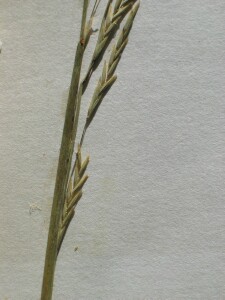 Emerging flower-head of Australian Sweet-grass Photo: A J Brown |
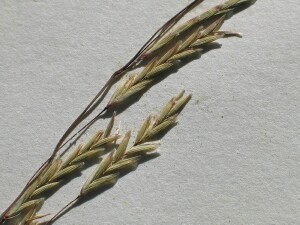 Spikelets of Australian Sweet-grass Photo: A J Brown |
