Victorian Resources Online (archived)
Caldwell's Club-rush
Back | Salinity Indicator Plants Home | Common name home | Scientific name home | Photo Gallery | Glossary
| Caldwell's Club-rush photos | Family: Sedge (Cyperaceae) |
| Scientific Name: | Bolboschoenus caldwellii |  Stand of Caldwell's Club-rush Photo: A J Brown | ||||||
Other Common Name: | Sea Club-sedge | |||||||
Status: | Native to Australia and New Zealand. | |||||||
Plant Description: | A perennial sedge with a rhizomatous root system. The smooth and hairless, triangular stems are from 30-90 cm high and 1-3.5 mm diameter and having several nodes (swollen bumps) from which 2-7 mm wide leaves arise. Flower-heads is a compact head of 3-6 spikelets or with 1-3 spikelet clusters on 1-4 cm long branches. The several flower bracts (leaf-like extensions of the stem) are from 4 to 22 cm long. Fruit is a lens-shaped, straw-coloured to dark golden brown, shiny nut with concave faces, 3.5-4 mm long and 2.5-3 mm diameter. | |||||||
Habitat: | Locally common in the cooler south-west part of Victoria. Mainly grows on the fringes of lakes and in marshes. Appears to tolerate some salinity. Often found with other Club-rush species.
| |||||||
Comments: | Two other Bolboschoenus species grow in Victoria. Marsh Club-rush (B. medianus) grows in a similar range and habitat to Cadwell’s Club-rush but is mainly distinguished in having a dark red-brown to black nut. The other species; B. fluviatilis is uncommon and chiefly grows on lake margins in the eastern part of the State. It has a pale yellow or grey nut with equal triangular faces. These Club-rushes are similar to general appearance to other medium to large rush-like plants, such as River Club-rush (Schoenoplectus validus), Sharp Club-rush (S. pungens) and Giant Rush (Juncus ingens) but differ in flower-heads and fruit and in having leafy stems. | |||||||
 Flowering spikelet of Caldwell's Club-rush Photo: A J Brown |  Flower-heads of Caldwell's Club-rush Photo: A J Brown |
 Leaf of Caldwell's Club-rush Photo: A J Brown |  Caldwell's Club-rush on lake edge Photo: A J Brown |
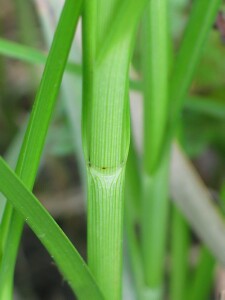 Stems of Caldwell's Club-rush Photo: A J Brown |  Leaf and stem junction of Caldwell's Club-rush Photo: A J Brown |
