Victorian Resources Online (archived)
Fat Hen
Back | Salinity Indicator Plants Home | Common name home | Scientific name home | Photo Gallery | Glossary
| Fat Hen photos | Family name: Chenopodiaceae (Saltbush Family). |
| Scientific Name: | Chenopodium album | 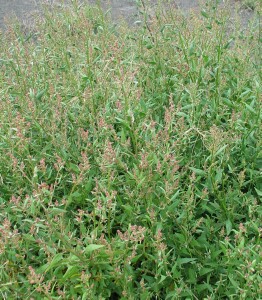 Fat Hen plants Photo: A J Brown | |||||
Other Common Names: | Lambsquarters, Lambs Quarter, Mutton Tops, Pigweed, Bacon Weed, White Goosefoot, Wild Spinach, Allgood. | ||||||
Status: | Introduced to Australia from Europe and eastern Asia. | ||||||
Plant Description: | An erect, almost odourless, annual, herb growing to 1.5-2.5 m high with angular stems. Lower leaves rhombic to ovate and 3-5 cm long but up to 10 cm and upper leaves elliptic to linear. Leaf surfaces mealy (with a powdery or floury covering) but particularly so on the lower and whitish to greyish or bluish-green. Flower-heads are in panicles, the larger being leafy but not obscuring the flowers. Flowers are greyish or greenish and clustered, bisexual or female, consisting of 5 parts (perianth segments) fused in the lower half. Stamens 5. Seed 1-1.5 mm diameter, black and smooth. | ||||||
Habitat: | Mainly a weed of waste places, roadsides, stock-yards and horticultural cropping soils but can be found in or on the edges of saline sites.
| ||||||
Comments: | Fat Hen derived its name from being used for fattening poultry. It is also grown as a human food crop (either as grain or a green vegetable) in parts of Africa and Asia, including northern India, where it is known as Bathua, or as a fodder crop for cattle. It has been found as a food source in archaeological sites dating back to Roman and Iron Age. Fat Hen is similar to Sowbane (Chenopodium murale) but differs in having reduced leaves within the flower-head. The Goosefoots and some Saltbush species (e.g. Orache - Atriplex prostrata) are similar in their vegetative stage and often difficult to tell apart without fruit. |
Fat Hen Photos
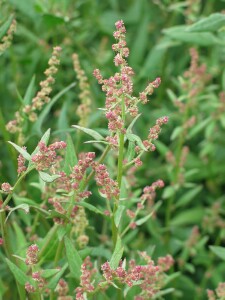 Fat Hen flowers Photo: A J Brown |  Flat Hen flower-head Photo: A J Brown |
| |