Victorian Resources Online (archived)
Great Brome
Back | Salinity Indicator Plants Home | Common name home | Scientific name home | Photo Gallery | Glossary
| Great Brome photos | Family Name: Grass (Poaceae syn. Gramineae) |
| Scientific Name: | Bromus diandrus | 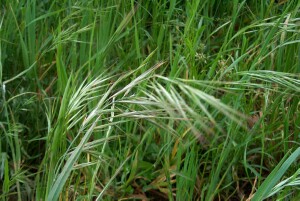 Great Brome plants Photo: A J Brown | |||||||||||
Status: | Native to the Mediterranean and south-west Europe. Naturalised across Australia. | ||||||||||||
Plant Description: | Tufted annual grass to 80 cm tall. Leaves are covered in soft spreading hairs, are flat or loosely folded and up to 15 cm long and 10 mm wide. Flower-head is a loose, drooping, panicle to 15 cm long. Spikelets contain 4-10 florets, subtended by outer glumes of 13-27 mm length; the lower being shorter than the upper. The lemma (larger of the inner flowering bracts) has two rough, membranous, apical lobes, 4-7 mm long and a more or less straight awn or bristle from 35-60 mm length. | ||||||||||||
Habitat: | A common and widespread weed of pastures, crops, roadsides and waste ground but also encroaches on wetlands and the higher parts of saline flats.
| ||||||||||||
Comments: | There are about 12 species of Brome-grasses found in Victoria, all but one being introduced exotics. Other common species include Soft Brome (Bromus hordeaceus) and Red Brome (B. rubens). Great Brome can be a serious pest to cereal growers and to sheep farmers, when mature spikelets dislodge and become entangled in fleeces. | ||||||||||||
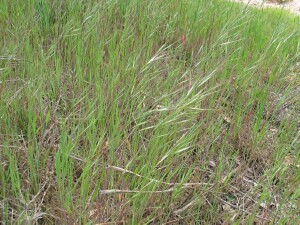 Great Brome plants Photo: A J Brown | 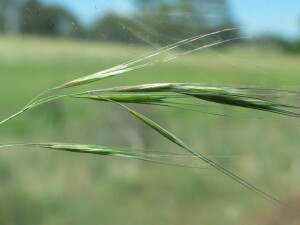 Great Brome spikelets Photo: A J Brown |
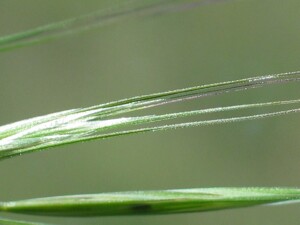 The long awns of Great Brome Photo: A J Brown | 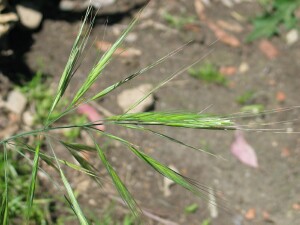 Great Brome spikelets Photo: A J Brown |
