Victorian Resources Online (archived)
Quaking Grasses
Back | Salinity Indicator Plants Home | Common name home | Scientific name home | Photo Gallery | Glossary
| Quaking Grass photos | Family Name: Grass (Poaceae syn. Gramineae) |
| Scientific Name: | Briza spp. | 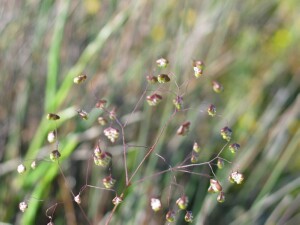 Spikelets of Lesser Quaking Grass | |||||
Status: | Native to the Mediterranean region. | ||||||
Plant Description: | Tufted annual grasses with hairless leaves to 20 cm long and 10 mm wide. Flower-heads are slender, open, panicles with capillary branches. Spikelets are plump and drooping. Two species in Victoria: Large Quaking Grass or Shelly Grass (Briza maxima) has 7-20 flowered spikelets, 10-25 mm long and 8-15 mm wide; Lesser Quaking Grass (Briza minor) has 4-8 flowered spikelets, 3-5 mm long and wide. | ||||||
Habitat: | Widespread (except for the Mallee) and common grasses, growing in waste-land, roadsides and other disturbed areas. Also found on the edges of swamps, lakes and water courses. Generally indicative of fresh-water habitats, these grasses may be found on the fringes of wet saline areas.
|
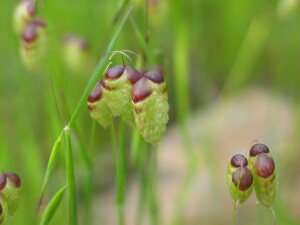 Flower-head of Large Quaking Grass Photo: A J Brown |
