Victorian Resources Online (archived)
Hare's-tail Grass
Back | Salinity Indicator Plants Home | Common name home | Scientific name home | Photo Gallery | Glossary
| Hare's-tail Grass photos | Family: Grass (Poaceae syn. Gramineae) |
| Scientific Name: | Lagurus ovatus | 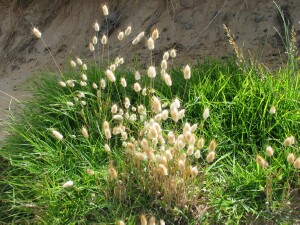 Hare's-tail Grass plants Photo: A J Brown | |||||
Other Common Names: | Bunny Tails, Turk’s-head Grass | ||||||
Status: | Native to the Mediterranean but naturalised around the world, including all Australian States except the Northern Territory. | ||||||
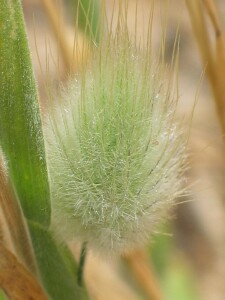
Plant Description: | Small annual grass to 60 cm high but often much shorter. Leaves grey-green and velvety, to 20 cm long and 15 mm wide. Flower-head a near-globular or cylindrical to tear-drop shaped, contracted panicle, 1-7 cm long and 1-2 cm wide. Spikelets softly hairy and awned (soft bristles); silvery-green when young and becoming soft grey to white with brown bristles on maturity. | ||||||
Habitat: | Common on coastal sand dunes and on sandy soils of inland parts. Although tolerant of salt-spray, Hare’s-tail Grass is not normally found in saline soil environments. Occasionally it does grow on sandy ridges on the edges of salt-lakes in western parts of the State and in the Gippsland Lakes.
| ||||||
Comments: | The flower-heads of this species are sometimes prized for their form and colour in flower arrangements. |
 Mature flower-head of Hare's-tail Grass Photo: A J Brown |  Young flower-head of Hare's-tail Grass Photo: A J Brown |
|
|