Victorian Resources Online (archived)
Sedges
Back | Salinity Indicator Plants Home | Common name home | Scientific name home | Photo Gallery | Glossary
| Sedge photos | Family: Sedge (Cyperaceae) |
| Scientific Name: | Carex spp. | ||||||
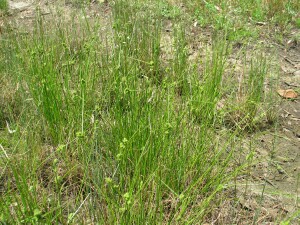
Status: | Australian natives and introduced species. | 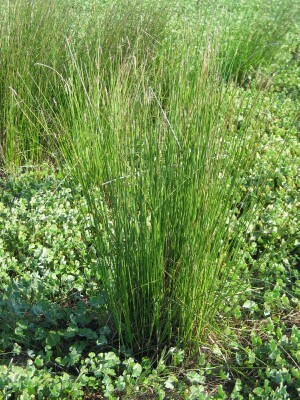 A large tussock forming Sedge plant Photo: A J Brown | |||||
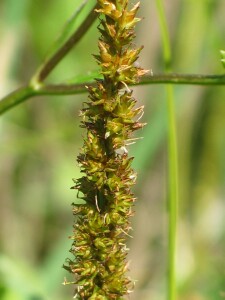
Plant Description: | Perennial tufted or rhizomatous sedges, mostly with triangular stems without nodes but with basal leaves. Flower-heads mainly spike-like; nodding in some species but often stiff and erect. Spikelets consist of a single flower in the axils of the spirally arranged glumes. The genus is typified by having the pistil, and therefore later, the nut, enclosed in a bottle shaped covering called a utricle. | ||||||
Habitat: | These sedges occupy a wide variety of habitats, from alpine to coastal and from dry grasslands and woodlands to wet depressions, swamps and the edges of lakes and streams. Only a few species are found in north-west Victoria. Generally indicative of non-saline environments.
| ||||||
Comments: | A large genus of sedges with over 1500 species world-wide, about 60 species in Australia and 34 recorded for Victoria. The more common species that occupy wetter environments include Tassel sedge (Carex fascicularis), Fen Sedge (Carex gaudichaudiana), Tall Sedge (Carex appressa), Common Sedge (Carex tereticaulis) and Knob Sedge (Carex inversa). |
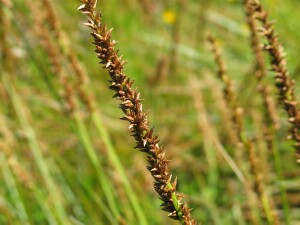
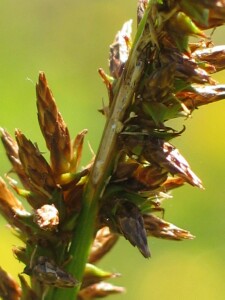
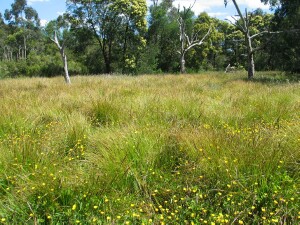 A field of Tall Sedge Photo: A J Brown | 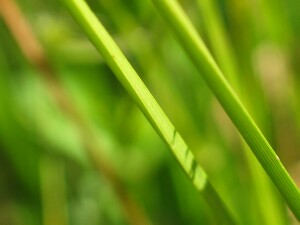 Stems of Tall Sedge Photo: A J Brown |
|
|
|
|
|
|