Victorian Resources Online (archived)
Water Bent
Back | Salinity Indicator Plants Home | Common name home | Scientific name home | Photo Gallery | Glossary
| Water Bent photos | Family: Grass (Poaceae syn. Gramineae) |
| Scientific Name: | Polypogon viridis (Agrostis viridis, Agrostis semiverticillata) | 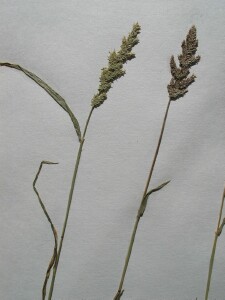 Water Bent plants Photo: A J Brown | |||||
Status: | Native to the Mediterranean region. | ||||||
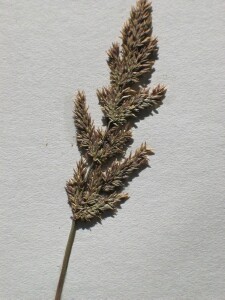
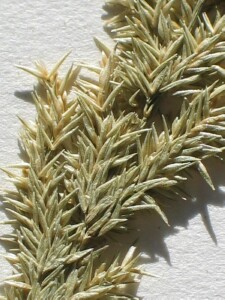
Plant Description: | Perennial grass with stolons (above-ground, trailing stems that root at their nodes). Erect stems to 100 cm high with hairless but rather rough, flat leaves to 15 cm long and 5 mm wide. Flower-heads are rather dense panicles to 12 cm long and 4 cm wide with a somewhat lobed appearance due to clustering of the spikelets towards the base of the branches. Spikelets are single flowered, each floret about 1 mm long, without hairs or awns. | ||||||
Habitat: | Occasional across southern Victoria, on damp to wet sites, including roadside drains and irrigation ditches.
| ||||||
Comments: | This species has always been difficult to place taxonomically as it has the general appearance of a Bent Grass (Agrostis) but the seed dispersal of a Beard-grass (Polypogon). Like Annual Beard-grass (Polypogon monspeliensis), the spikelets of Water-bent fall as a whole when mature, whereas the flower-heads of the Bent Grasses discard the florets only, leaving the glumes behind. Water Bent is most similar to Creeping Bent (Agrostis stolonifera) which differs in having a more open flower-head and slightly larger florets. |