Victorian Resources Online (archived)
Water Couch
Back | Salinity Indicator Plants Home | Common name home | Scientific name home | Photo Gallery | Glossary
Water Couch Photos
| Scientific Name: | Paspalum distichum |  Water Couch forming a dominant ground-cover mat Photo: A J Brown |
Status: | Native to many tropical and warm-temperate countries. Unknown status in Australia but may consist of both native and naturalised elements. | |
Plant Description: | Semi-aquatic, perennial grass with long rhizomes and stolons. Stems erect or ascending to 60 cm tall. Stem nodes (swollen growing points) often hairy. Leaves acutely to sharply pointed, blades flat to 20 cm long and 7 mm wide, hairless but ciliate along margins of blades and sheaths. Flower-heads of two terminal racemes of 2-6 cm long. Spikelets in two rows, elliptic in shape, 2.5-3.5 mm long, finely hairy. | |
Habitat: | Common in or near fresh water, such as river banks, marshes, swamps, depressions, drains and wet cultivated land. May tolerate some brackishness. | |
Comments: | Along with Paspalum (P. dilatatum), Water Couch is usually indicative of freshwater environments, unlike Salt Couch (Sporobolus virginicus) which grows under saline conditions | |
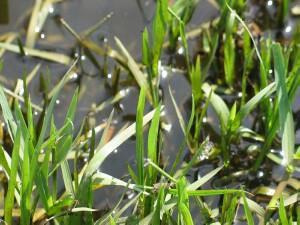 Water Couch growing in fresh water Photo: A J Brown | 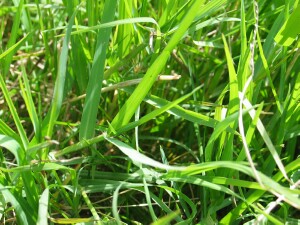 Leaves of Water Couch Photo: A J Brown |
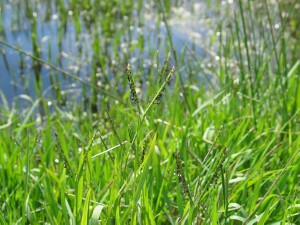 Flowering Water Couch Photo: A J Brown | 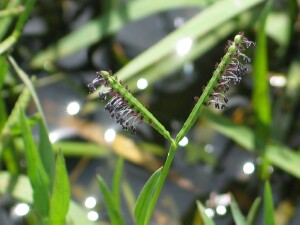 Flowering racemes of Water Couch Photo: A J Brown |
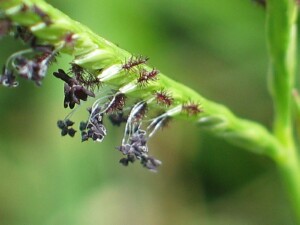 Water Couch spikelets with exserted anthers and stigmas Photo: A J Brown |
