Victorian Resources Online (archived)
Wild Oats
Back | Salinity Indicator Plants Home | Common name home | Scientific name home | Photo Gallery | Glossary
Wild Oats photos
Family: Grass (Poaceae syn. Gramineae) |
| Scientific Name: | Avena fatua | 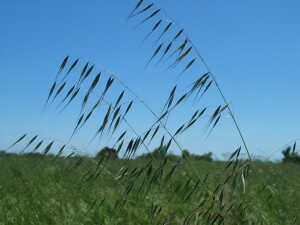 Wild Oats flower-heads Photo: A J Brown | ||||||||
Other Common Names: | Wild Oat | |||||||||
Status: | Native to southern Europe but naturalised throughout Australia. | |||||||||
Plant Description: | Tufted annual grass to 150 cm high with hairless leaves to 45 cm long and 15 mm wide. Flower-heads are open and spreading panicles, 40 cm long and 20 cm wide. Spikelets are drooping, 18-25 mm long (excluding awns). Each spikelet has 2-3 florets, then lower being 14-20 mm long. Each floret is sparely silky hairy in the lower half, has 2-4 1 mm long teeth at its apex and a slender, strongly bent, black awn arising from its mid-back region. Florets fall separately from the spikelet, when mature. | |||||||||
Habitat: | Widespread across most of Victoria, although only scattered in the Alps. A common weed of cereal crops, pastures, roadsides and waste places, including the margins of swamps, lakes and streams.
| |||||||||
Comments: | Other Oat species growing in Victoria with which Wild Oats may be confused include Cultivated Oats (Avena sativa) with its hairless and awnless (or shortly awned to 20 mm) florets and Bearded Oats (Avena barbata) with its densely hairy florets and florets that terminate in two fine bristles 3-12 mm long in addition to its awn. | |||||||||
Photos of Wild Oats
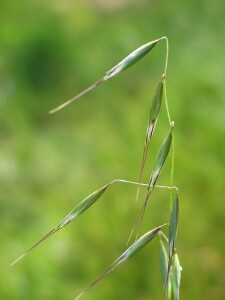 Wild Oats spikelets Photo: A J Brown | 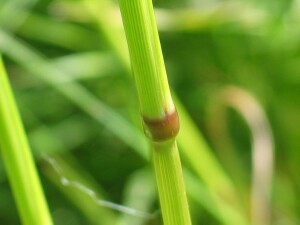 Stem and node of Wild Oats Photo: A J Brown |
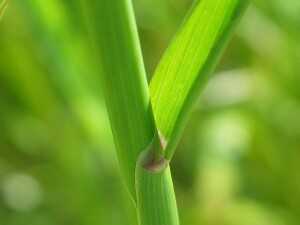 Wild Oats ligule at junction of leaf and stem Photo: A J Brown |
