Victorian Resources Online (archived)
Willow-Leaf Lettuce
Back | Salinity Indicator Plants Home | Common name home | Scientific name home | Photo Gallery | Glossary
Family: Daisy (Asteraceae syn. Compositae |
| Scientific Name: | Lactuca saligna |  Willow-leaf plants Photo: A J Brown | |||||
Other Common Names: | Least Lettuce, Wild Lettuce | ||||||
Status: | Native to Europe and western Asia. Naturalised throughout most of Australia. | ||||||
Plant Description: | Annual or biennial herb to 100 cm high with erect and branched stems. Leaves, 8-20 cm long and 0.5-5 cm wide, green with a pale whitish midrib. Lower leaves with a few narrow backward pointing lobes. Upper leaves linear and without lobes, becoming bract-like below the flower-heads. Flower-heads, 2-3 in leaf axils, 7-10 mm long. Flowers pale yellow with each ‘petal’ (actually a complete flower) 4-5 mm long. Fruit a cypsela, 5-9 mm long, grey-brown. | ||||||
Habitat: | Scattered across northern and western parts of Victoria. Often growing with Prickly Lettuce (Lactuca serriola) in wasteland and on the margins of streams, lakes and swamps. Appears to be tolerant of some salinity.
| ||||||
Comments: | Willow-leaf Lettuce belongs to a group of mainly yellow-flowered daisies in the Tribe Lactuceae. The plants in this tribe are characterised by having a basal rosette of leaves (flat-weeds), milky sap in their stems and their flower-heads consisting entirely of ray florets (i.e. no ‘eye’ to the daisy). See Key to Yellow Daisy Flat-weeds. | ||||||
- Photos of Willow-leaf Lettuce
 Willow-leaf Lettuce leaves and stem Photo: A J Brown | 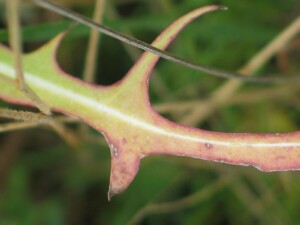 Willow-leaf Lettuce basal leaf Photo: A J Brown |
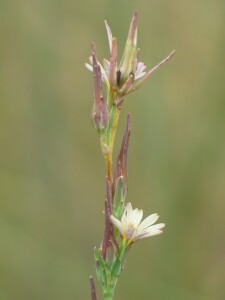 Flowers and buds of Willow-leaf Lettuce Photo: A J Brown | 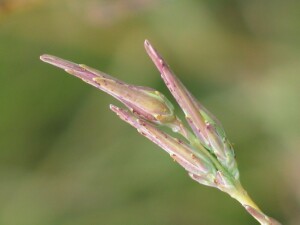 Willow-leaf Lettuce buds Photo: A J Brown |
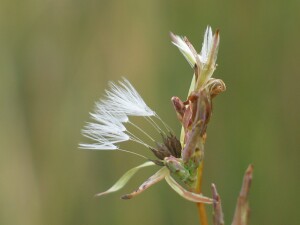 Mature seed of Willow-leaf Lettuce Photo: A J Brown |  Willow-leaf Lettuce flower Photo: A J Brown |
