Victorian Resources Online (archived)
Victorian State Soil Contender - Brown Chromosol

Back to: Contenders for State Soil
Why should the Brown Chromosol be Victoria’s State Soil?
- Brown Chromosols are scattered widely across Victoria and have developed on a wide range of landforms and geology (see examples at bottom of this page). They are common in the Glenelg-Hopkins region where they occur on a variety of landscapes, including basalt plains and the Dundas Tablelands as well as some granite areas. Other smaller occurrences of Brown Chromosols include parts of the Corangamite region, particularly adjacent to the Otways ranges; on some steep hills in Central Gippsland (mainly north of Maffra), as well as in some parts of the Goulburn Broken and North East regions (particularly lower Ovens and King catchments). Brown Chromosols are common on the Mornington Peninsula and to the east of Melbourne (e.g. Cranbourne, Coldstream areas) where they support a number of vineyards and also vegetable cropping where surface horizons are fairly deep with a sandy to sandy loam texture.
- These soils have a wide range of agricultural uses including cereal and oilseed cropping, vineyards, intensive horticulture, and grazing.
- Brown Chromosols may not be the first choice of most people, but may be a compromise between the "difficult" Sodosols and the "boutique" Red Ferrosols.
- In older landscapes in south-west Victoria (e.g. the Dundas Tablelands) the deep subsoils of Brown Chromosols can have distinctive banded or reticulated mottling - referred to evocatively as "tiger mottles".
- Brown Chromosols occupy less of the state than either Brown or Red Sodosols.
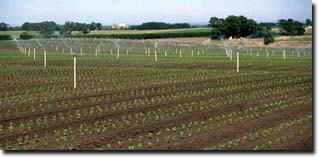 Celery cropping on Brown Chromosols near Cranbourne. | 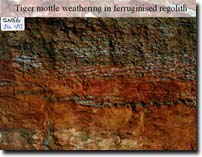 "Tiger mottles" in ferruginised regolith under Brown Chromosol in southwest Victoria. |
- Chromosols are texture contrast soils with a sandy or loamy surface horizon overlying a clay-textured B horizon. The subsoil (B) horizon is not strongly acid (pH greater than 5.5) and it is not sodic in the upper 20 cm. The structure of the subsoil may range from massive to strongly structured. Brown Chromosols have brownish coloured upper subsoils.
- These soils generally have good soil physical properties, but can become hardsetting after long periods of cropping. Some Chromosols have bleached subsurface (A2) horizons indicating poor internal drainage and seasonal waterlogging. In south-western Victoria, the subsurface horizons also often contain many ferruginous nodules (i.e. "buckshot"). Subsoils usually allow for better root and water movement compared to dispersive Sodosols.
Typical soil profile
| This example Brown Chromosol occurs in the Cranbourne area. It has formed on a gently undulating plain of windblown (aeolian) material overlying sandstone. | 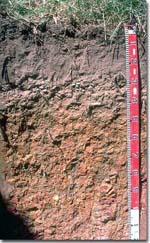 Brown Chromosol near Cranbourne. | ||
| Surface Soil | |||
| A1 | 0-20 cm | Dark brown sandy loam; neutral pH. | |
| A2 | 20-35 cm | Sporadically bleached light sandy loam; slightly acid pH; sharp change to: | |
| Subsoil | |||
| B21 | 35-80 cm | Yellowish brown medium clay; moderate angular blocky structure; slightly acid pH; | |
| B22 | 80-120 cm | Light grey medium clay; strong polyhedral structure; slightly acid pH. | |
Other examples of Red Sodosols on the Victorian Resources Online website
Brown Chromosol on the Dundas Tableland in south-west Victoria.
Brown Chromosol on granite hills near Ararat.
Brown Chromosol on gently undulating basalt plain near Coleraine in south-west Victoria.
Brown Chromosol on alluvial sediments near Nambrok in West Gippsland.
