Victorian Resources Online (archived)
Common Wallaby-grass
Back | Salinity Indicator Plants Home | Common name home | Scientific name home | Photo Gallery | Glossary
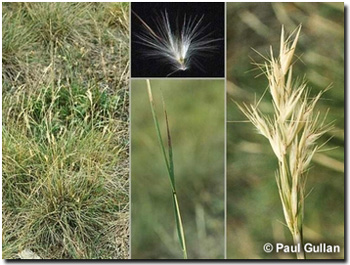
| Common Wallaby-grass photos | Family: Grass (Poaceae syn. Gramineae) |
| Scientific Name: | Rytidosperma caespitosum (syn. Austrodanthonia caespitosa) | |||||||
Other Common Name: | Ringed Wallaby-grass, Wallaby Grass, White Top Wallaby-grass | |||||||
Status: | Native to Victoria, Western Australia, South Australia, New South Wales and Tasmania. | |||||||
Plant Description: | Tall, tufted perennial grass from 20 – 90 cm tall, with dense tussocky base to 12 cm diameter. Stems smooth, slender to rather robust with 2 – 4 hairless nodes. Leaves to 30 cm long, 1 – 3 mm wide, flat or loosely in-rolled, hairy to hairless. Ligule a ciliate rim (0.5 mm long) with a tuft of longer hairs at the sides (1-2 mm long). Flower-head, a purplish, contracted panicle, 3 – 8 cm long with 10 – 30 or more spikelets; appearing bleached and fluffy when mature and dry. Spikelets contain 6-9 closely overlapping florets, each of which have two lateral rows of long hairs on the back and a hairy base. The body of the floret is usually 3.5 – 5.5 mm long, ending in two 7 – 15 mm long acuminate lobes with a bent and twisted, rather stout awn arising from the notch between the lobes. Flowering spring, infrequently at other times. | |||||||
Habitat: | Mostly on clay soils, and less frequently on sandy loam, or loamy red earths. Found in a wide range of communities, but is a dominant species in black box and grassland communities.
| |||||||
Comments: | Common Wallaby-grass is a very variable species with some forms approaching Bristly Wallaby-grass. Common Wallaby-grass usually has larger florets than Bristly Wallaby-grass but the bristles (long acuminate points) on its floret lobes are shorter (2 – 4 mm long). | |||||||
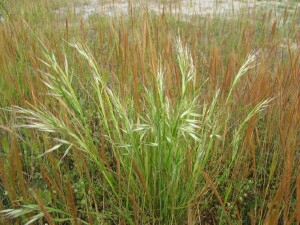 Common Wallaby-grass - emerging flowerheads Photo: A J Brown | 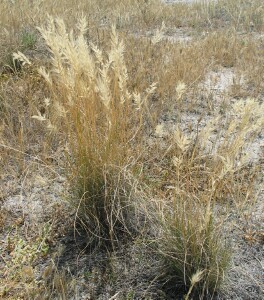 Common Wallaby-grass - mature plants Photo: A J Brown |
|

