Victorian Resources Online (archived)
Lesser Canary-grass
Back | Salinity Indicator Plants Home | Common name home | Scientific name home | Photo Gallery | Glossary
| Lesser Canary-grass photos | Family: Grass (Poaceae syn. Gramineae) |
| Scientific Name: | Phalaris minor |  Stand of Lesser Canary-grass Photo: A J Brown | ||||||||
Status: | Native to the Mediterranean and western Europe but widely naturalised. | |||||||||
Plant Description: | Tufted annual grass to 100 cm high with hairless leaves to 30 cm long and 12 mm wide. The flower-heads are dense, cylindrical, spike-like panicles from 2-6 mm long. Spikelets are 4.5-6 mm long with 3-nerved glumes having irregularly toothed wings on the central nerve (or keel). Each spikelet has 3 flowers but often the lowest is minute or absent and only the upper is fertile. | |||||||||
Habitat: | Widespread across Victoria; mainly on roadsides, in irrigation ditches or on low-lying and moist areas.
| |||||||||
Comments: | Similar to other Canary-grasses, including Phalaris (Phalaris aquatica) and Paradoxical Canary-grass (P. paradoxa), from which it is largely distinguished by the nature of its winged glumes. | |||||||||
 Flower-heads of Lesser Canary-grass Photo: A J Brown | 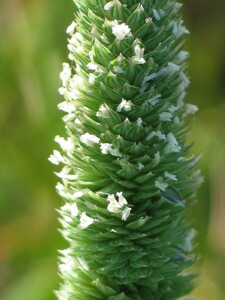 Spikelets of Lesser Canary-grass with exserted anthers Photo: A J Brown |
