Victorian Resources Online (archived)
Phalaris
Back | Salinity Indicator Plants Home | Common name home | Scientific name home | Photo Gallery | Glossary
| Photos of Phalaris | Family Name: Grass (Poaceae syn. Gramineae) |
| Scientific Name: | Phalaris aquatic (syn. Phalaris tuberosa) | 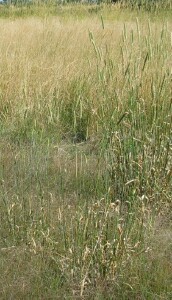 Phalaris plants at the end of the growing season Photo: A J Brown | ||||||||
Other Common Names: | Toowoomba Canary-grass, Harding Grass, Bulbous Canary-grass | |||||||||
Status: | Native to southern Europe but naturalised throughout Australia. | |||||||||
Plant Description: | Shortly rhizomatous perennial grass to 160 cm high with smooth, hairless leaves to 30 cm long and 20 mm wide. The lower internodes of the stems are often swollen. Flower-heads are dense, cylindrical, spike-like panicles from 5-15 mm long. Spikelets are 5.5-7 mm long with 3-nerved, glumes with wings on the central nerve (or keel). Each spikelet has 3 flowers but the lower two are sterile and only one-quarter to one-third as long as the fertile flower, which is 3-4 mm long. | |||||||||
Habitat: | Widespread across most of Victoria but only scattered in the Mallee and Alps. Grown as a valuable pasture grass but often found as an escapee on low-lying roadsides, in ditches and the margins of swamps, lakes and rivers. Usually associated with heavier textured soils.
| |||||||||
Comments: | Distinguished from Reed Canary-grass (Phalaris arundinacea) by its non-branched but dense spike-like flower-heads but superficially similar in this regard to the annuals; Lesser Canary-grass (Phalaris minor) and Paradoxical Canary-grass (Phalaris paradoxa). Phalaris is often slow to establish but once it has an extensive root system, it can readily become the dominant plant of a site and particularly when not controlled by grazing, slashing or burning. In these situations it can be a troublesome weed, a potential fire hazard and haven for vermin. Some cultivars of Phalaris have been developed that have moderate salt tolerance and there is some evidence that as even non-selected plants mature, they develop greater salt tolerance. |
Photos of Phalaris
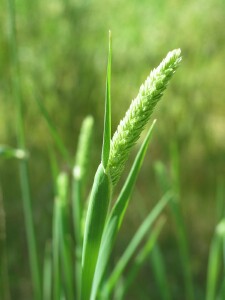 Emerging flower-head of Phalaris Photo: A J Brown | 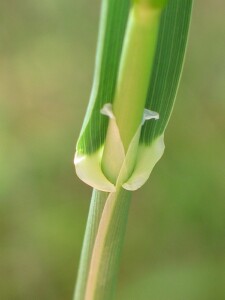 Ligule of Phalaris Photo: A J Brown |
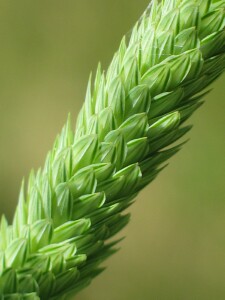 Spikelets of Phalaris Photo: A J Brown | 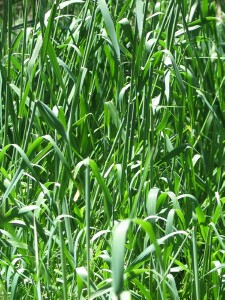 Dense stand of Phalaris Photo: A J Brown |
