Victorian Resources Online (archived)
Manuka
Back | Salinity Indicator Plants Home | Common name home | Scientific name home | Photo Gallery | Glossary
| Manuka photos |
| Scientific Name: | Leptospermum scoparium | 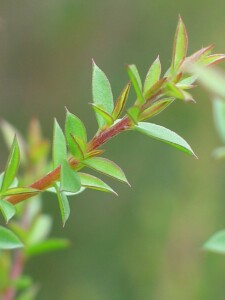 Manuka leaves Photo: A J Brown | |||||
Other Common Name: | Broom Tea-tree | ||||||
Status: | Australian native to Victoria, New South Wales, Queensland and Tasmania. Also in New Zealand. | ||||||
Plant Description: | Shrub to 2 m tall with close, firm bark and silky younger stems and softly hairy new growth. Leaves broad-lanceolate (spear-shaped) 7-15 mm long and 2-6 mm wide with incurved margins and a sharply pointed tip. Flowers solitary, 8-12 mm diameter, white or occasionally pink or red. Flower-cup 2-3 mm long and hairless. Petals 4-7 mm long and stamens 2.5-3.5 mm long. Fruit 6-9 mm diameter. | ||||||
Habitat: | Grows in rocky soils and heathy sands but also on the fringes of fresh-water swamps and along water courses.
| ||||||
Comments: | There are 80 species of Tea-tree native to Australia and 18 species listed for Victoria. Unlike Paperbarks (Melaleuca spp.), of which a number are salt tolerant, Tea-trees tend to be confined to fresh-water environments and many grow in quite dry habitats. Coast Tea-tree (Leptospermum laevigatum) is tolerant of salt-spray. | ||||||
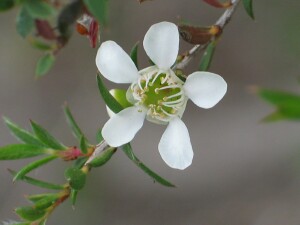 Manuka flower Photo: A J Brown | 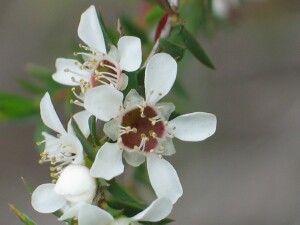 Manuka flowers Photo: A J Brown |
|
|