Victorian Resources Online (archived)
Woolly Tea-Tree
Back | Salinity Indicator Plants Home | Common name home | Scientific name home | Photo Gallery | Glossary
| Woolly Tea-Tree photos |
| Scientific Name: | Leptospermum lanigerum | 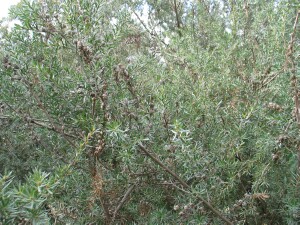 Woolly Tea-tree Photo: A J Brown | |||||
Other Common Names: | River Tea-tree, Silky Tea-tree | ||||||
Status: | Australian native to Victoria, New South Wales, Tasmania and eastern South Australia. | ||||||
Plant Description: | Shrub to small tree with close bark. Younger stems softly hairy and new growth often silvery. Leaves oblong to narrow-oblanceolate, 3-15 mm long and 2-4 mm wide, usually recurved with an infolded and blunt apex, softly hairy on the lower surface. Flowers white, solitary, about 15 mm diameter. Cup densely hairy. Fruit 5-10 mm diameter, woolly at first, becoming scaly afterwards. | ||||||
Habitat: | Grows in sandy swamps and along water courses in scrub and woodland. Indicative of fresh-water habitats.
| ||||||
Comments: | There are 80 species of Tea-tree native to Australia and 18 species listed for Victoria. Unlike Paperbarks (Melaleuca spp.), of which a number are salt tolerant, Tea-trees tend to be confined to fresh-water environments and many grow in quite dry habitats. Coast Tea-tree (Leptospermum laevigatum) is tolerant of salt-spray. | ||||||
 Woolly Tea-tree fruit Photo: A J Brown |  Stem and fruit of Woolly Tea-tree Photo: A J Brown |
|

