Victorian Resources Online (archived)
Archived content — This page contains material from the Victorian Resources Online (VRO) website. It is no longer maintained and is provided for reference only. This content is hosted by CeRDI and is not endorsed by Agriculture Victoria.
Sitemap
Couch Grass
Back | Salinity Indicator Plants Home | Common name home | Scientific name home | Photo Gallery | Glossary
| Scientific Name: | Cynodon dactylon | 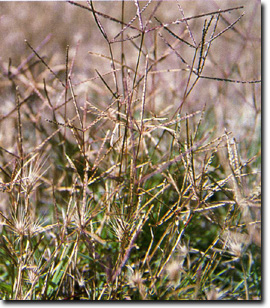
Couch Grass
Ex Matters & Bozon |
Other Common Name:
|
Swamp Couch, Common Couch
|
Status: |
Widespread throughout Australia and around the world. Some authorities regard it as being indigenous to Australia but it may have been an early introduction. |
Plant Description:
|
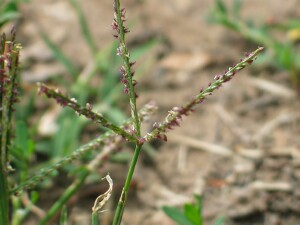
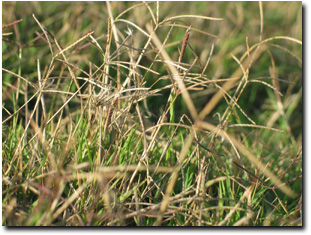
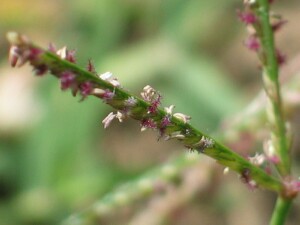
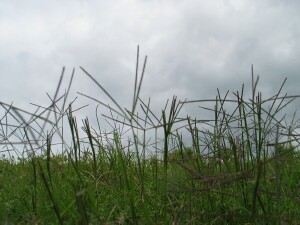
A tough creeping or erect mat-forming perennial grass with stolons (runners/horizontal stems) and rhizomes (underground stems). The leaves are hairless or minutely hairy, narrow and taper to a point. Flower-heads are like the spokes of an umbrella or windmill, with up to 6 spikes radiating from the end of the flower stalk. The spikes are usually straight but they are sometimes slightly curved. The spikelets are overlapping, and arise in 2 rows on the underside of the spikes, are up to 2 mm long and have one floret each. Flowering in summer and autumn.
|
Habitat:
|
Wide range of soils from sand to heavy clays.
Prefers moist sites such as stream sides, roadside drains and plains which are occasionally flooded. It is also able to tolerate dry sites and forms dense mats in favourable conditions. It is tolerant of slightly to moderately saline soils but more common in slightly saline soils.
Commonly reported as having high salt tolerance and varieties have been selected for good salt tolerance but the species is rarely found growing naturally in saline situations.
|
Comments: |
Widely used as a turf grass species because of its fine mat-forming and hard-wearing characteristics
There are several grasses with similar windmill-like flower-heads. Curly Windmill-grass (Enteropogon acicularis) and Windmill-grass (Chloris truncata) tend to occur as individual tufted plants and do not (or hardly) spread by stolons or rhizomes. Couch Grass has smaller flower-heads with fewer spikes and unawned florets, compared to the windmill grasses.
See Comments under Australian Salt-grass (Distichlis distichophylla) for leaf differences between this species and other similar creeping grasses. |
Couch Grass Photos