Victorian Resources Online (archived)
Windmill Grass
Back | Salinity Indicator Plants Home | Common name home | Scientific name home | Photo Gallery | Glossary
| Windmill Grass photos | Family: Grass (Poaceae syn. Gramineae) |
| Scientific Name: | Chloris truncata | 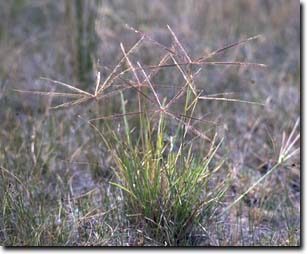 Windmill Grass Ex Matters & Bozon | |||||
Other Common Name: | Umbrella Grass, Star Grass | ||||||
Status: | Native to all mainland States of Australia but not in the Northern Territory. | ||||||
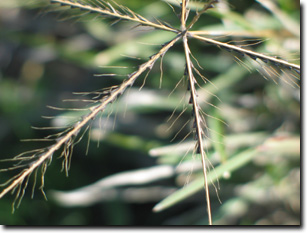
Plant Description: | Annual or perennial, tufted grass, up to 40 cm tall, with flattened stems and coarse, straight, flat to folded leaves up to 15 cm long and 5 mm wide. Windmill-like flower-head of 5 – 10 spikes, 5 – 17 cm long, radiating from the end of a stalk. Spikelets are arranged along the spike, alternately in two rows; each spikelet consisting of two truncated florets (i.e. flat-topped) and an awn (5 – 15 mm long for the lower floret). Florets turn from green to purplish when mature and to black when ripe. Flowers from spring to autumn, but mainly in the summer. | ||||||
Habitat: | Occurs in most soil types but prefers red earths and grey clays.
| ||||||
Comments: | There are several grasses with similar windmill-like flower-heads. Windmill-grass and Curly Windmill-grass tend to occur as individual tufted plants and have large flower-heads with many spikes and have awned florets, whereas Couch Grass (Cynodon dactylon) spreads along and through the ground by stolons and rhizomes (often forming mats), has up to 6 spikes only and its florets are awnless. Curly Windmill-grass (Enteropogon acicularis), unlike Windmill-grass, has narrow-lanceolate (spear-like) florets. Occurs extensively in pastures and can be dominant in some areas where a disturbance has weakened the existing shrub species. The species is a colonizer of some eroded soils and scalded areas. Readily grazed when young but becomes unpalatable with age. | ||||||
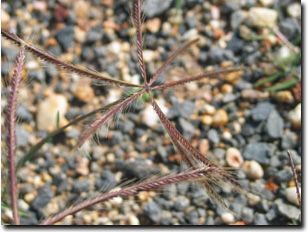 Windmill Grass - Seedhead Photo: A J Brown | 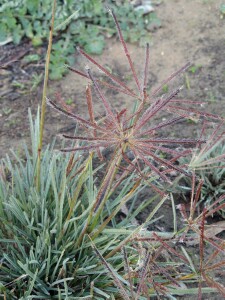 Windmill Grass - mature plant Photo: A J Brown | |
|